

经典物理中的局域实在性(local realism)表示任意类空间隔的两方的测量结果不会受到对方测量基选择的影响,其各自的测量结果可由局域隐变量模型刻画[1⇓⇓-4]。而量子力学表现出的非局域性是经典物理的局域隐变量模型所不能刻画的。近些年,量子非局域性受到越来越多的关注并且在量子信息处理任务中得到广泛应用,例如量子密钥分发[5]、随机数扩展[6]、自测试[7]等。
经典物理的局域性与量子世界的非局域性不兼容,可由贝尔不等式进行刻画。以最简单的贝尔测试场景[5-6]为例,即CHSH 贝尔测试(如图1)。源制备一对粒子,分别发送给类空间隔的两方Alice和Bob,他们独立随机选择测量基,Alice侧的测量选择为j(j∈{0,1}),Bob侧的测量选择为k(k∈{0,1}),其对应的测量结果分别记作a、b,经过多次测量,统计其输入、输出,所表现的关联关系由如下线性表达式刻画:
ICHSH=E(A0B0)+E(A0B1)+E(A1B0)-E(A1B1),
式中E(AjBk)= abp(a,b)|j,k)。ICHSH≤2表明Alice和Bob之间表现的关联关系是局域的;若该不等式被违背,使得2<ICHSH<2 ,则表明他们之间存在量子非局域关联。由此,贝尔不等式成为探测量子非局域性的基本工具。

为了给量子信息处理任务设计更安全实用的协议,设备无关的思想应运而生。设备无关的概念表示对所处的复杂物理系统不进行细致刻画,仅借助贝尔测试对该物理系统的输入-输出进行刻画[5⇓⇓⇓⇓-10]。由此,设备无关的量子信息处理任务的安全性由贝尔不等式的违背来保证。例如,若随机数发生器的制造商在设备中恶意地预先存储一串满足随机性检测条件的比特串作为其输出,一般的量子随机数发生器是无法检测出上述欺骗行为的;而设备无关量子随机数发生器是可以检测出的,因为随机的输入与预先存储的输出不能使贝尔不等式发生违背。
在实际应用中,贝尔不等式自身存在的漏洞如自由选择漏洞[11⇓⇓⇓⇓⇓-17]、探测漏洞[18⇓⇓⇓⇓-23]、时间一致漏洞[24⇓⇓-27],可导致借助局域隐变量模型伪造贝尔不等式违背,进而导致设备无关的量子信息处理任务的安全性受到威胁。自由选择漏洞是指通过局域隐变量控制测量选择的部分随机性构建其输出,致使输入-输出没有产生非局域关联却伪造出贝尔违背[11⇓⇓⇓⇓⇓-17]。探测漏洞是指局域隐变量控制探测器是否响应(即是否有测量结果),致使输入-输出没有产生非局域关联却伪造出贝尔违背[18⇓⇓⇓⇓-23]。时间一致漏洞是指隐变量控制探测器的响应时间使得输入-输出误匹配,导致输入-输出没有产生非局域关联却伪造出贝尔违背[24⇓⇓-27]。为了消除贝尔不等式自身存在的漏洞对设备无关量子信息处理任务的安全性威胁,直接而有效的方法是关闭掉其存在的漏洞。目前,关闭贝尔不等式的漏洞的研究成果见表1。
表1 不同类型贝尔不等式的漏洞研究Tab.1 Loophole research about different Bell inequalities |
| 类型 | 代表的贝尔不等式 | 探测漏洞 | 自由选择漏洞 | 时间一致漏洞 |
|---|---|---|---|---|
| (2,2,2) | CHSH,CH | 文献[12] | 文献[12-13] | 文献[24] |
| (2,M,2) | 链式CHSH | 文献[20] | 文献[14,16] | 文献[27] |
| (N,2,2) | Svetlichny | 文献[23] |
注:(N,M,K)表示该贝尔不等式由N个参与方、每个参与方有M组测量、每组测量有K个测量结果组成。 |
不难发现,(2,2,2)和(2,M,2)类型对应的贝尔不等式的自由选择漏洞、探测漏洞和时间一致漏洞都被关闭。对于(N,2,2)类型,其研究成果相对较少。Svetlichny不等式的探测漏洞被关闭,而自由选择漏洞、时间一致漏洞还有待研究。同时,Svetlichny不等式的违背意味着真正的多体关联(genuine multipartite correlation)[28],对设备无关的量子随机数生成协议、多方密码协议的设计提供新途径。研究Svetlichny不等式还未被关闭的漏洞,对于设备无关的多体量子密码协议的安全性至关重要,本文主要关注Svetlichny不等式的时间一致漏洞。对于时间一致漏洞的研究,Larsson等研究CHSH不等式的情况得出:关闭时间一致漏洞时,时间一致事件的概率临界值为0.878 7,即当时间一致的事件概率大于0.878 7时,CHSH不等式对时间一致漏洞免疫[24]。Jogenfors等研究链式(chained)CHSH不等式得出:关闭其时间一致漏洞,其临界时间一致的事件概率为 ,其中M表示每方有M个测量[27]。这两类贝尔不等式都是针对两个参与方的场景,虽然链式CHSH不等式每一方的测量个数有所增加,但是每一组期望{p(a,b|j,k)}统计的形式并没有变化。不同于这两类贝尔不等式的研究,Svetlichny不等式需要考虑更多参与方加入后带来的影响,例如多参与方情况下时间一致事件的定义。同时,重合计数器(coincidence counters)在现有含背景噪声的量子光学实验中发挥着重要的作用,现有量子光学设备的精进度使得计数器能够具备高计数率的能力[29⇓⇓-32]。高精度的计数器使得本文研究关闭时间一致漏洞的实验成为可能。
1 预备知识
局域/非局域关联 不失一般性,这里考虑最简单的贝尔场景下的关联关系刻画:2个参与方,每方两组测量(即j,k∈{0,1}),各方的每组测量对应2个测量结果(分别是a,b∈{-1,+1}),其表现的关联由联合概率分布{p(a,b|x,y)}刻画,如果概率p(a,b|x,y)满足
p(a,b|x,y)= p(λ)p(a|j,λ)p(b|k,λ),
式中λ∈Λ表示隐变量,则表明两方之间表现的关联关系是局域的,否则是非局域的。
Svetlichny不等式[28] 一般地,假设n个参与方共享n粒子态,每方独立随机地选择拥有的2组测量中的1组,并作用在各自的粒子上,n方执行的测量记作x1,x2,…,xl,…,xn,其中xl∈{0,1}表示第l方选择的测量,相应的测量结果记作 ,取值为+1或-1,那么Svetlichny不等式可表示为
$ \begin{aligned} S_{n}= & \mid \sum_{x_{1}, x_{2}, \cdots, x_{l}, \cdots, x_{n}} v\left(x_{1}, x_{2}, \cdots, x_{l}, \cdots, x_{n}\right) \cdot \\ & E\left(A_{x_{1}}, A_{x_{2}}, \cdots, A_{x_{l}}, \cdots, A_{x_{n}}\right) \mid \leqslant 2^{n-1} 。 \end{aligned}$
式中:v(x1,x2,…,xl,xn)=(-1)d(d-1)/2,d表示在一组测量(x1,x2,…,xl,…,xn)中编码为1的测量个数;E( , ,…, ,…, )表示该组测量(x1,x2,…,xl,…,xn)的期望,即
E(, ,…, ,…, )= … … p(, ,…, ,…, |x1,x2,…,xl,…,xn)。
式(3)的右侧结果表示局域关联下的上确界,若式(3)被违背,则意味着量子非局域关联的存在,其可达的上确界是2n-1 。
特别地,当n=3时,3个参与方分别记为Alice、Bob和Carol,式(3)被表示为
S3=|E(A0B0C0)+E(A0B0C1)+E(A0B1C0)+E(A1B0C0)-E(A0B1C1)-E(A1B0C1)-E(A1B1C0)-E(A1B1C1)|≤4,
该式左侧能达到量子非局域的上确界为4 。
时间一致事件 不失一般性,以两方贝尔实验为例,源设备生成一对粒子,分别发送给两方进行测量,各方独立自由地选择两组测量中的1组作用在对所接收的粒子上。理想条件下,同时发送的一对粒子,两方探测器响应的时间相同,这样的事件为时间一致事件[24]。但是,在实际实验过程中,同时发送的一对粒子,由于受噪声等因素的影响会导致两方探测器响应未必同时发生,多次实验导致很难判定探测器的响应对应两方选择的哪对测量。为了克服噪声等带来的影响,会定义恰当的时间窗口。例如,源设备把一对粒子同时发送给Alice和Bob,各自在收到粒子后执行自己随机选择的测量,若Alice侧与Bob侧探测器响应时间小于等于预定时间窗口,称为时间一致事件[25]。式(3)是在理想条件(所有事件均为时间一致事件)下的结果。
时间一致漏洞 由上述可知,时间一致事件把探测器响应时间的同时性由理论上落在同一个时间点推至落在同一个时间窗。窗口过大会导致更多的事件落入,无法做出判断;窗口过小会导致把真实的时间一致事件丢弃掉,这样在计算贝尔表达式值时,仅一小部分被标记为时间一致的事件被计入,大量真正时间一致的事件被丢弃,导致贝尔不等式“误”违背,此违背只是表面违背,并非量子非局域性导致的。因此,当时间窗口过小时,就会出现时间一致漏洞。
由此,若要关闭时间一致漏洞,需要设置恰当的时间窗口,但是由于粒子在传输过程中受距离、环境等多种因素的影响,导致很难直接给出一个通用的时间窗口大小。相比之下,在任一时间窗口下,时间一致事件是方便计数的,可以通过时间一致事件概率来刻画关闭此漏洞需要满足的条件。实际上,当时间一致事件的概率被确定,也就找到了恰当的时间窗口。
2 结果
2.1 三方Svetlichny不等式的情况
假设3个参与方分别为Alice、Bob和Carol,他们的测量分别是i、j和k,对于任意一组测量(i,j,k),其探测器响应时间由依赖于测量的隐变量刻画,分别记作 , 和 :
$\begin{array}{l} T_{i, j, k}^{(1)}: \Lambda \rightarrow R^{+}, \lambda \mapsto T_{i, j, k}^{(1)}(\lambda), \\ T_{i, j, k}^{(2)}: \Lambda \rightarrow R^{+}, \lambda \mapsto T_{i, j, k}^{(2)}(\lambda), \\ T_{i, j, k}^{(3)}: \Lambda \rightarrow R^{+}, \lambda \mapsto T_{i, j, k}^{(3)}(\lambda) 。 \end{array}$
时间一致事件Λi,j,k表示该组测量的探测器响应时间小于等于某一预设时间窗口(记作Δt)。以数学语言规范描述如下:
={λ| (λ)∈[T,T+Δt]},
={λ| (λ)∈[T,T+Δt]},
={λ| (λ)∈[T,T+Δt]},
Λi,j,k= ∩ ∩ ={λ| (λ), (λ), (λ)∈[T,T+Δt]}。
={λ| (λ)∈[T,T+Δt]},
={λ| (λ)∈[T,T+Δt]},
Λi,j,k= ∩ ∩ ={λ| (λ), (λ), (λ)∈[T,T+Δt]}。
式中:子事件 、 、 之间是彼此独立的;T表示某一时刻。
等价地,
Λi,j={λ|| (λ)- (λ)|≤Δt},
Λj,k={λ|| (λ)- (λ)|≤Δt},
Λi,k={λ|| (λ)- (λ)|≤Δt},
Λi,j,k=Λi,j∩Λj,k∩Λi,k。
Λj,k={λ|| (λ)- (λ)|≤Δt},
Λi,k={λ|| (λ)- (λ)|≤Δt},
Λi,j,k=Λi,j∩Λj,k∩Λi,k。
那么,在时间一致漏洞存在的情况下,蕴含局域关联的S3(式(5))的规范表达为
|E(A0B0C0)|ΛI)+E(A0B0C1|ΛI)+E(A0B1C0|ΛI)+E(A1B0C0|ΛI)-E(A0B1C1|ΛI)-E(A1B0C1|ΛI)-E(A1B1C0|ΛI)-E(A1B1C1|ΛI)|≤4。
式中ΛI= Λi,j,k表示S3中所有测量组合下时间一致事件的交集,注意这里的0~7表示(i,j,k)的二进制三元组对应的十进制表达。
引理1 定义δ3= ,对于任意的测量组(i,j,k),则δ3≥18γ2-17,其中p(ΛI)表示S3中所有测量组合下时间一致事件的交集的概率,γ2=inf p(Λ-,-),-,-表示任意测量(i,j,k)的任意二元组。
证明 由定义可知δ= =p(ΛI|Λi,j,k),不失一般性,取(i,j,k)为(0,0,0), 此时,
δ3=p(ΛI|Λ0,0,0)=p(Λ0,0,0∩Λ0,0,1∩Λ0,1,0∩Λ1,0,0∩Λ1,0,1∩Λ0,1,1∩Λ1,1,0∩Λ1,1,1|Λ0.0.0)≥1+p(Λ0,0,1|Λ0,0,0)+p(Λ0,1,0|Λ0,0,0)+p(Λ1,0,0|Λ0,0,0)+p(Λ1,0,1|Λ0,0,0)+p(Λ0,1,1|Λ0,0,0)+p(Λ1,1,0|Λ0,0,0)+p(Λ1,1,1|Λ0,0,0)-7。
从上述表达式各项看,有如下情况:1)与测量(0,0,0)相比,仅有1个测量不同的项有3项(即(0,0,1)、(0,1,0)、(1,0,0));2)与测量(0,0,0)相比,有2个测量不同的项有3项(即(0,1,1)、(1,1,0)、(1,0,1));3)与测量(0,0,0)相比,3个测量都不同的项有1项(即(1,1,1))。
下面对上述3种不同的情况进行讨论。
1)仅有1个测量不同,如(i,j,k)与(i',j,k):
p(Λi',j,k|Λi,j,k)=p(Λi',j∩Λi',k∩Λj,k|Λi,j,k)≥p(Λi',j|Λi,j,k)+p(Λi',k|Λi,j,k)+p(Λj,k|Λi,j,k)-2=p(Λi',j|Λi,j,k)+p(Λi',k|Λi,j,k)-1=p(Λi',j)+p(Λi',k)-1≥2γ2-1,
倒数第三步的结果基于p(Λj,k|Λi,j,k)=1,倒数第二步的结果基于Λi',j,k中的子事件Λi',j与Λi,j,k是独立的,最后一步的结果中令γ2=inf p(Λ-,-)。
2)有2个测量不同。
p(Λi',j',k|Λi,j,k)=p(Λi',j'∩Λi',k∩Λj',k|Λi,j,k)≥p(Λi',j'|Λi,j,k)+p(Λi',k|Λi,j,k)+p(Λj',k|Λi,j,k)-2≥3γ2-2,
该式的推导类似于情况1)。
3)3个测量都不同。
p(Λi',j',k'|Λi,j,k)=p(Λi',j'∩Λi',k'∩Λj',k'|Λi,j,k)≥p(Λi',j'|Λi,j,k)+p(Λi',k'|Λi,j,k)+p(Λj',k'|Λi,j,k)-2≥3γ2-2,
同样地,该式的推导类似于情况2)。
那么,
δ3=p(ΛI|Λ0)≥3(2γ2-1)+4(3γ2-2)-6=18γ2-17,
式中γ2=inf p(Λ-,-),-,-表示任意测量组的任意二元组。
引理2 ∀(i,j,k),有|E(AiBjCk|Λi,j,k)-δ3E(AiBjCk|ΛI)|≤1-δ3,其中δ3= 。
|E(AiBjCk|Λi,j,k)-δ3E(AiBjCk|ΛI)|=|E(AiBjCk|ΛI∪ )-δ3E(AiBjCk|ΛI)|=p(ΛI|Λi,j,k)E(AiBjCk|ΛI)+p( |Λi,j,k)E(AiBjCk| )-δ3E(AiBjCk|ΛI)|≤|p( |Λi,j,k)E(|AiBjCk|| )|+|{p(ΛI|Λi,j,k)-δ3}E(|AiBjCk||ΛI)|≤p( |Λi,j,k)+p(ΛI|Λi,j,k)-δ3=1-δ3。
引理3 若关闭时间一致漏洞,三方Svetlichny不等式重构为
$\overline{\overline{S}}_3$=|E(A0B0C0|Λ000)+E(A0B0C1|Λ001)+E(A0B1C0|Λ010)+E(A1B0C0|Λ100)-E(A0B1C1|Λ011)-E(A1B0C1|Λ101)-E(A1B1C0|Λ110)-E(A1B1C1|Λ111)|≤4(19-18γ2),
式中γ2=inf p(Λ-,-)。
证明 首先,
$\overline{\overline{S}}_3$=|E(A0B0C0|Λ000)+E(A0B0C1|Λ001)+E(A0B1C0|Λ010)+E(A1B0C0|Λ100)-E(A0B1C1|Λ011)-E(A1B0C1|Λ101)-E(A1B1C0|Λ110)-E(A1B1C1|Λ111)|=|[E(A0B0C0|Λ000)-δ3E(A0B0C0|ΛI)+E(A0B0C1|Λ001)-δ3E(A0B0C1|ΛI)+E(A0B1C0|Λ010)-δ3E(A0B1C0|ΛI)+E(A1B0C0|Λ100-δ3E(A1B0C0|ΛI)-E(A0B1C1|Λ011)+δ3E(A0B1C1|ΛI)-E(A1B0C1|Λ101)+δ3E(A1B0C1|ΛI)-E(A1B1C0|Λ110)+δ3E(A1B1C0|ΛI)-E(A1B1C1|Λ111)+δ3E(A1B1C1)|ΛI)]-δ3[E(A0B0C0|ΛI)+E(A0B0C1|ΛI)+E(A0B1C0|ΛI)+E(A1B0C0|ΛI)-E(A0B1C1|ΛI)-E(A1B0C1|ΛI)-E(A1B1C0|ΛI)-E(A1B1C1|ΛI)]|≤|E(A0B0C0|Λ000)-δ3E(A0B0C0|ΛI)|+|E(A0B0C1|Λ001)-δ3E(A0B0C1|ΛI)|+|E(A0B1C0|Λ010)-δ3E(A0B1C0|ΛI)|+|E(A1B0C0|Λ100)-δ3E(A1B0C0|ΛI)|+|E(A0B1C1|Λ011)-δ3E(A0B1C1|ΛI)|+|E(A1B0C1|Λ101)-δ3E(A1B0C1|ΛI)|+|E(A1B1C0|Λ110)-δ3E(A1B1C0|ΛI)|+|E(A1B1C1|Λ111)+δ3E(A1B1C1|ΛI)|+δ3|E(A0B0C0|ΛI)+E(A0B0C1|ΛI)+E(A0B1C0|ΛI)+E(A1B0C0|ΛI)-E(A0B1C1|ΛI)-E(A1B0C1|ΛI)-E(A1B1C0|ΛI)-E(A1B1C1|ΛI)|≤8(1-δ3)+4δ3≤4(19-18γ2)。
上述推导中,基于引理2可得,对任意(i,j,k),|E(AiBjCk|Λi,j,k)-δ3E(AiBjCk|ΛI)|≤1-δ3;基于绝对值的性质及式(8)可得倒数第二步的结果,基于引理1可得最后一步的结果。
定理1 若关闭时间一致漏洞,三方Svetlichny不等式重构为
$\overline{\overline{S}}$=|E(A0B0C0|Λ000)+E(A0B0C1|Λ001)+E(A0B1C0|Λ010)+E(A1B0C0|Λ100)-E(A0B1C1|Λ011)-E(A1B0C1|Λ101)-E(A1B1C0|Λ110)-E(A1B1C1|Λ111)|≤4(19-18 ),
式中γ3表示时间一致事件概率的最小值。
证明 令时间一致事件的概率为γ3=p(Λi,j,k),则
γ3=p(Λi,j,k)=p(Λi,j∩Λi,k∩Λj,k)=p(Λi,j)×p(Λi,k)×p(Λj,k)≥ ,
式中各子事件间是独立的,γ2=inf p(Λ-,-),-,-表示任意测量组的任意二元组。
把γ3的结果带入引理3的结论中,可得
$\overline{\overline{S}}_3$≤4(19-18γ2)≤4(19-18 )。
推理1 若关闭时间一致漏洞,三方Svetlichny不等式达到最大违背需满足:γ3≥0.932 6,其中γ3表示三方时间一致事件概率的最小值。
2.2 一般情况
一般情况下,设定参与方为n,对于任意一组测量(x1,x2,…,xl,…,xn),其探测器响应时间由依赖于测量的隐变量刻画,记作( , ,…, ,…, )。
$\begin{array}{l} T_{\left(x_{1}, x_{2}, \cdots, x_{l}, \cdots, x_{n}\right)}^{(1)}: \Lambda \rightarrow \mathbf{R} \\ \lambda \mapsto T_{\left(x_{1}, x_{2}, \cdots, x_{l}, \cdots, x_{n}\right)}^{(\lambda)} \text {, } \\ \text {... } \\ \end{array}$
$\begin{array}{l} T_{\left(x_{1}, x_{2}, \cdots, x_{l}, \cdots, x_{n}\right)}^{(l)}: \Lambda \rightarrow \mathbf{R}^{+} \\ \lambda \mapsto T_{\left(x_{1}, x_{2}, \cdots, x_{l}, \cdots, x_{n}\right)}^{(l)}(\lambda), \\ \quad \cdots \\ T_{\left(x_{1}, x_{2}, \cdots, x_{l}, \cdots, x_{n}\right)}^{(n)}: \Lambda \rightarrow \mathbf{R}^{+} \\ \lambda \mapsto T_{\left(x_{1}, x_{2}, \cdots, x_{l}, \cdots, x_{n}\right)}^{(n)}(\lambda) 。 \end{array}$
在n方的情况下,时间一致事件 表示该组测量的探测器响应时间小于等于某一预设时间窗口(记作Δt)。以数学语言规范描述如下:
={λ| (λ),
(λ),…,
(λ)≤[T,T+Δt]}。
(λ),…,
(λ)≤[T,T+Δt]}。
等价地,对于任意的测量组(x1,x2,…,xn),不同的l、u∈{1,2,…,n},满足
={λ‖ (λ)- (λ)|≤Δt},
= 。
= 。
那么,在时间一致漏洞存在的情况下,蕴含局域关联的Sn的规范表达为
$\begin{array}{l} \mid \sum_{x_{1}, x_{2}, \cdots, x_{l}, \cdots, x_{n}} v\left(x_{1}, x_{2}, \cdots, x_{l}, \cdots, x_{n}\right) \cdot \\ \quad E\left(A_{x_{1}}, A_{x_{2}}, \cdots, A_{x_{l}}, \cdots, A_{x_{n}} \mid \Lambda_{I}\right) \mid \leqslant 2^{n-1}, \end{array}$
其中ΛI= 。
引理4 定义参数δn= ,则
$\begin{aligned} \delta_{n} \geqslant & \sum_{s=0}^{n}\left(\begin{array}{l} n \\ s \end{array}\right)\left[\left\{\left(\begin{array}{l} n \\ 2 \end{array}\right)-\left(\begin{array}{c} n-s \\ 2 \end{array}\right)\right\} \gamma-\right. \\ & \left.\left\{\left(\begin{array}{l} n \\ 2 \end{array}\right)-\left(\begin{array}{c} n-s \\ 2 \end{array}\right)-1\right\}\right]-\left(2^{n}-1\right) 。 \end{aligned}$
证明 类似于引理1的证明,δn= =p(ΛI| )。
为了简洁,把 记作Λv,n元二进制组(x1,x2,…,xn)表示为十进制数v,自然地,ΛI记作ΛI= Λw,那么,
$\begin{aligned} \delta_{n}= & p\left(\Lambda_{I} \mid \Lambda_{x_{1}, x_{2}, \cdots, x_{n}}\right)=p\left(\bigcap_{0}^{2^{n}-1} \Lambda_{w} \mid \Lambda_{v}\right)= \\ & \sum_{0}^{2^{n}-1} p\left(\Lambda_{w} \mid \Lambda_{v}\right)\left(2^{n}-1\right) 。 \end{aligned}$
对于2n项的p(Λw|Λv),n元二进制组中存在0~n位不同,共n+1种不同的情况。由于0位不同的情况最简单,即p(Λv|Λv)=1,下面就其他情况进行讨论。
设s(1≤s≤n)个测量不同,如(x'1,x'2,…,x's,…,xn)与(x1,x2,…,xn),该情况在2n项的p(Λw|Λv)中占 项:
p( | )=p( ∩ ∩…∩ | )≥p( | )+…+p( | )+…+p( | )- =p( | )+…+p( | )+ - ≥ γ- 。
那么,
$\begin{aligned} \delta_{n}= & \sum_{0}^{2^{n}-1} p\left(\Lambda_{w} \mid \Lambda_{v}\right)-\left(2^{n}-1\right) \geqslant \\ & \sum_{s=0}^{n}\left(\begin{array}{l} n \\ 2 \end{array}\right)\left[\left\{\left(\begin{array}{l} n \\ 2 \end{array}\right)-\left(\begin{array}{c} n-s \\ 2 \end{array}\right)\right\} \gamma-\left\{\left(\begin{array}{l} n \\ 2 \end{array}\right)-\right.\right. \\ & \left.\left.\left(\begin{array}{c} n-s \\ 2 \end{array}\right)-1\right\}\right]-\left(2^{n}-1\right)= \\ & \sum_{s=0}^{n}\left(\begin{array}{l} n \\ 2 \end{array}\right)\left\{\left(\begin{array}{l} n \\ 2 \end{array}\right)-\left(\begin{array}{c} n-s \\ 2 \end{array}\right)\right\}(\gamma-1)+ \\ & \sum_{s=0}^{n}\left(\begin{array}{l} n \\ 2 \end{array}\right)-\left(2^{n}-1\right)= \\ & {\left.\left[2^{n}\left(\begin{array}{l} n \\ 2 \end{array}\right.\right)-\sum_{s=0}^{n}\left(\begin{array}{l} n \\ 2 \end{array}\right)\left(\begin{array}{c} n-s \\ 2 \end{array}\right)\right](\gamma-1)+1, } \end{aligned}$
其中当n-s≤0,则约定 =0。
引理5 若关闭时间一致漏洞,蕴含局域关联的n方Svetlichny不等式表示为
$\overline{\overline{S}}_n$=|v(x1,x2,…,xl,…,xn)E( , ,…, ,…, | )|≤2n-1+2n-1 (1-γ),
式中γ=inf p(Λ-,-),-,-,表示任意n元(x1,x2,…,xn)中的二元组。
证明
| v(x1,x2,…,xl,…,xn)E( , ,…, ,…, | )|=| {v(x1,x2,…,xl,…,xn)E( , ,…, ,…, | )-δnv(x1,x2,…,xl,…,xn)×E( , ,…, ,…, |ΛI)}+δn {v(x1,x2,…,xl,…,xn)×E( , ,…, ,…, |ΛI)|≤ |v(x1,x2,…,xl,…,xn)×E( , ,…, ,…, | )-δnv(x1,x2,…,xl,…,xn)×E( , ,…, ,…, |ΛI)|+
δn| {v(x1,x2,…,xl,…,xn)×E( , ,…, ,…, |ΛI)|≤2n(1-δn)+2n-1δn=2n-2n-1δn≤2n-2n-1 ,
其中上述推导中,对任意的(x1,x2,…,xn),
|E( , ,…, ,…, | )-δnE( , ,…, ,…, |ΛI)|≤1-δn,
该推导过程类似于2.1可得。
定理2 若关闭时间一致漏洞,蕴含局域关联的n方Svetlichny不等式表示为
$\overline{\overline{S}}_n$=|v(x1,x2,…,xl,…,xn)E( , ,…, ,…, | )|≤2n-1+2n-1 ,
式中γn=inf p( )。
证明 令时间一致事件的概率为γn=p( ),则
γn=p( )=p( ∩…∩ ∩…∩ )=p( )×…×p( )×…×p(Λx-1,xn)≥ ,
其中各个子事件间是独立的,式中γ=inf p(Λ-,-),-,-表示任意n元测量组的任意二元组。
把γn的结果带入引理5的结论中,可得
$\overline{\overline{S}}_n$≤2n-1+2n-1 (1-γ)≤2n-1+2n-1 。
推理2 若关闭时间一致漏洞,n方Svetlichny不等式达到最大违背需满足:
γn≥ ,
式中γn表示n方时间一致事件概率的最小值。
2.3 讨论
首先,在重构后的Svetlichny不等式中,分析中,分析$\overline{\overline{S}}_n$与γn的关系(如图2所示)。
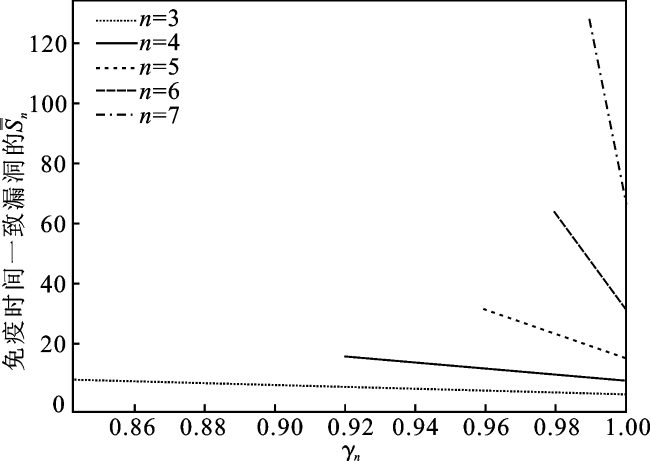


从图2可得,当γn=1,意味着所有事件均为时间一致事件,其关系恰好对应式(3)。随着参与方的增多,若实现真正的局域违背,时间一致事件的概率越高。这样,随着参与方的增多,对于敌手来说,借助时间一致漏洞伪造其违背的难度变得更大。
其次,分析关闭Svetlichny不等式的时间一致漏洞与探测漏洞之间的关系。当该不等式达到最大的量子违背2n-1 时(式中n表示参与方的个数),关闭探测漏洞与时间一致漏洞分别满足的临界探测效率与临界时间一致时间概率如表2所示,其中单方的探测效率η= ,Θtotal表示发送到该方的粒子数,Θdetected表示该方探测到的粒子数,即测量结果为{+1,-1}的数量。
表2 关闭Svetlichny不等式的探测漏洞与时间一致漏洞的对比Tab.2 Comparations between detection loophole and coincidence-time loophole of Svetlichny inequality which are closed |
| n | η | ηn | γ | γn |
|---|---|---|---|---|
| n=3 | 0.966 63 | 0.903 20 | 0.976 99 | 0.932 54 |
| n=4 | 0.987 22 | 0.949 86 | 0.994 25 | 0.965 79 |
| n=5 | 0.994 85 | 0.974 50 | 0.998 27 | 0.982 87 |
| n=6 | 0.997 85 | 0.987 15 | 0.999 42 | 0.991 41 |
| n=7 | 0.999 08 | 0.993 55 | 0.999 79 | 0.995 69 |
注:η表示单侧临界探测效率,ηn表示n方临界探测效率,γ表示时间一致子事件临界概率,γn表示n方时间一致事件概率。 |
从表2中不难发现,对于不同的参与方数量,临界时间一致事件概率总是大于临界探测效率,这是因为临界时间一致事件不仅要求探测到粒子,同时要求探测器响应的时间落在预设的时间窗内。这也就意味着若想关闭掉时间一致漏洞,临界时间一致事件的概率一定是大于临界探测效率的;另一方面,若已知临界时间一致事件的概率,若以该结果要求临界探测效率定能关闭探测漏洞。
最后,分析参与方的测量数量变化与参与方数量变化对关闭时间一致漏洞的影响。下面以链式CHSH不等式与Svetlichny不等式为例说明。
从表3中可得,在达到各自最大的量子违背时,在测量数量与参与方数量变化相同的条件下,Svetlichny不等式的临界时间一致事件概率要大于链式CHSH不等式的情况。这样,我们发现要关闭时间一致漏洞,参与方的数量变化比单个参与方的测量数量变化要求更为苛刻,这是因为在同一个预设的时间窗内,要落入更多的子事件。
表3 关闭时间一致漏洞的对比Tab.3 Comparations between detection loophole and coincidence-time loophole of Svetlichny inequality which are closed |
| 数量变化 | ζm | γn |
|---|---|---|
| m=n=3 | 0.893 16 | 0.932 54 |
| m=n=4 | 0.909 62 | 0.965 79 |
| m=n=5 | 0.922 58 | 0.982 87 |
| m=n=6 | 0.932 55 | 0.991 41 |
| m=n=7 | 0.940 36 | 0.995 69 |
注:ζm表示每方m个测量的链式CHSH不等式达到量子违背2m cos 时的临界时间一致事件概率,γn表示n方Svetlichny不等式达到量子违背2n-1 时临界时间一致事件概率。 |
3 结语
贝尔不等式的违背是验证粒子间非局域关联的有效工具,因此贝尔不等式被广泛应用于设备无关的量子信息处理任务中。贝尔不等式自身存在的漏洞导致贝尔违背未必是非局域关联引起的,这样就威胁到设备无关的量子信息处理任务的安全性。本文研究Svetlichny不等式的时间一致漏洞问题。首先,从三方Svetlichny不等式入手,给出关闭三方Svetlichny不等式时间一致漏洞的条件;进一步,给出关闭n方Svetlichny不等式时间一致漏洞的条件:当时间一致事件的概率超过所给的临界值时,该时间一致漏洞被关闭。研究发现:关闭时间一致漏洞的临界时间一致事件的概率大于关闭探测漏洞的临界探测率,这是由于时间一致事件不仅要求探测结果是有效的,而且要求探测时间落在预设的时间窗。本文方法可推广应用于某些多观测量的齐次Bell不等式如CHSH型不等式(CHSH-type inequalities),未来将进一步研究更具一般性的Bell不等式的时间一致漏洞问题,同时研究如何构造无漏洞的Bell不等式,为设备无关的量子信息处理提供更安全的保障。