1 无机CsPbX3钙钛矿材料
1.1 晶体结构及光电性能
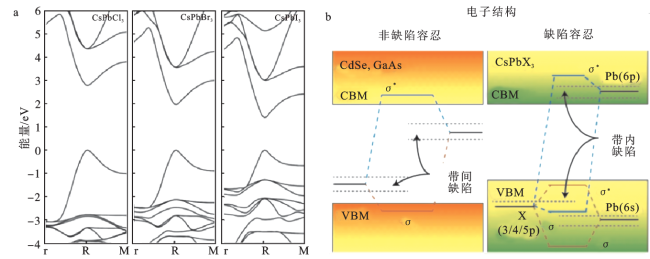
图3 立方相CsPbCl3、CsPbBr3和CsPbI3的电子能带结构计算(a)和传统半导体和CsPbX3半导体材料的电子能带结构示意图(b)Fig.3 Calculated electronic band structures for cubic-phase CsPbCl3, CsPbBr3 and CsPbI3(a); schematic representation of electronic band structure of traditional semiconductor and CsPbX3 semiconductor materials(b) |
1.2 无机钙钛矿薄膜制备
1.3 无机钙钛矿存在的问题
2 高性能无机PSCs的前驱体工程策略
2.1 组分优化
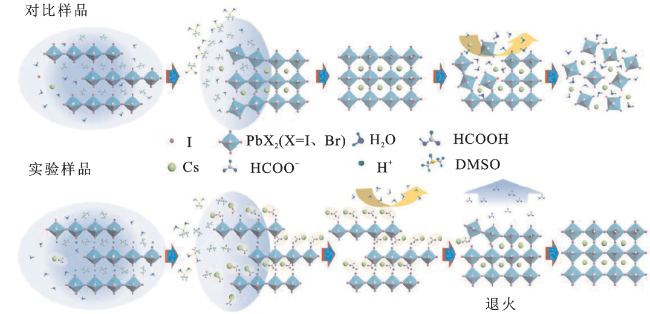
2.2 添加剂策略
2.2.1 路易斯碱类添加剂
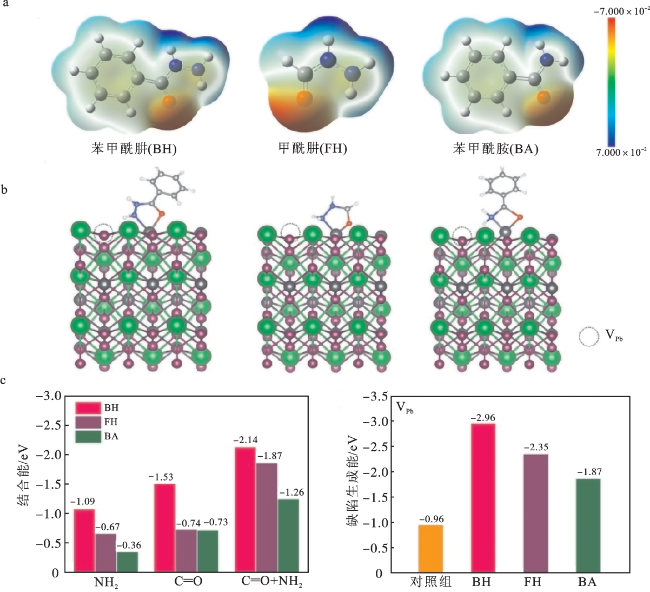
图6 BH、FH和BA的静电势(electrostatic surface potential, ESP)分析(a);Pb2+空位缺陷,以及Pb2+与BH、FH、BA通过C=O和氨基基团相互作用的模型和位点(b);NH2-Pb2+、C=O-Pb2+和(C=O+NH2)-Pb2+分别对BH、FH和BA的结合能和用BH、FH和BA处理的CsPbI3中Pb2+空位缺陷的生成能(c)注:修改自文献[94],网络版为彩图。 Fig.6 Electrostatic surface potential (ESP) analysis of BH, FH, and BA(a); the Pb2+ vacancy defect and the models and sites for interaction between under coordinated Pb2+ and BH, FH, and BA via C=O and NH2 groups(b); the binding energy of NH2-Pb2+, C=O-Pb2+ and (C=O+NH2)-Pb2+ for BH, FH and BA, and the formation energy of the Pb2+ vacancy defect in CsPbI3 treated by BH, FH and BA, respectively(c) |
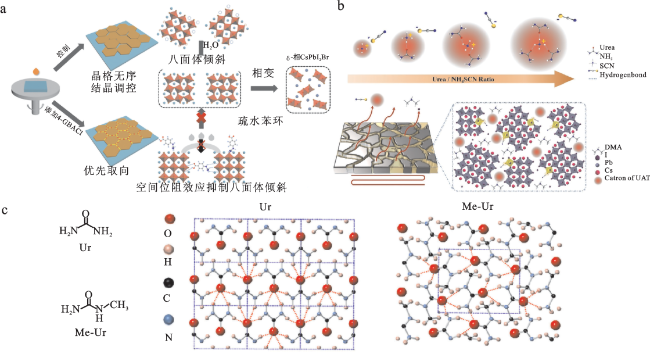
图8 基于4-GBACl添加剂CsPbI2Br薄膜和钙钛矿结构稳定性示意图(a);N 与尿素阳离子的配位作用及分布(b);Ur和Me-Ur的分子结构及分子间氢键网络(c)Fig.8 Schematic of CsPbI2Br film and perovskite structure stability with 4-GBACl additive(a); coordination and distribution of N and urea cations(b); molecular structures and intermolecular hydrogen bonding networks of Ur and Me-Ur(c) |
2.2.2 路易斯酸类添加剂
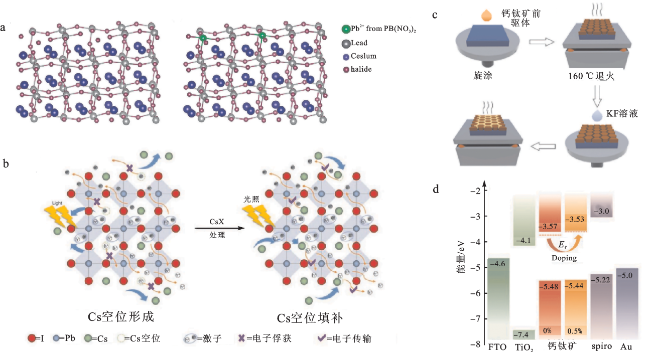
图9 Pb2+钝化钙钛矿薄膜表面缺陷示意图(a);铯盐后处理对电荷传输的影响示意图(b);KF作为表面钝化剂制备CsPbI2Br薄膜(c);CaCl2掺杂CsPbI2Br PSCs能级排列示意图(d)Fig.9 Schematic for the perovskite surface defects passivated by Pb2+(a); schematic diagram of the effect of Cs-salt post-treatment on charge transport (b); KF was used as surface passivating agent to prepare CsPbI2Br films(c); energy level arrangement of CaCl2 doped CsPbI2Br PSCs(d) |
2.2.3 离子液体添加剂
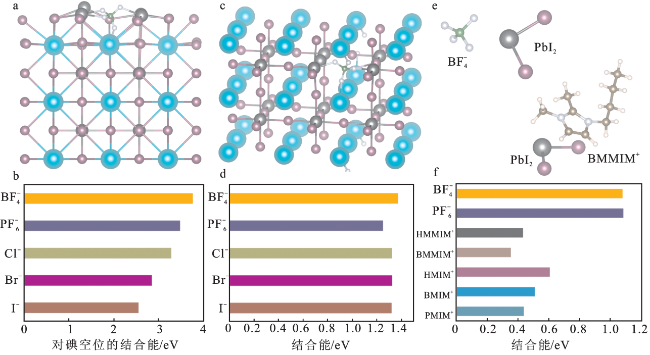
图11 B 阴离子钝化CsPbI2Br表面上的I-空位的计算结构说明(a);不同阴离子与钙钛矿表面I-空位的相互作用强度(b);Pb-I反位点与B 相互作用的计算结构说明(c);具有Pb-I反位缺陷的不同阴离子的结合能(d);PbI2与B 或BMMIM+相互作用的计算结构说明(e);不同离子与PbI2的结合能(f)注:修改自文献[113],网络版为彩图。 Fig.11 Calculated structure illustrating the passivation of an I- vacancy at the CsPbI2Br surface by a B anion(a); the relative interaction strengths of different anions with the I- vacancy at the surface of the perovskite (b); calculated structure illustrating the interaction of Pb-I antisite with B (c); the binding energy of different anions with Pb-I antisite defect(d); Calculated structure illustrating the interaction of PbI2 with B or BMMIM+(e); the binding energy of different ions with PbI2(f) |