
提高远距离成像的清晰度和对比度一直以来都是水下光学成像的研究热点[1],尤其是在浑浊水体环境中,散射颗粒对反射光具有强散射作用,会导致目标信息湮没在水体散射光中,从而严重影响水下光学成像的质量。传统的抑制水下背景光散射的方法主要可以分为图像增强方法和图像复原方法。图像增强方法是基于纯图像处理的方法,此类方法并未考虑散射对图像的影响,仅使用图像增强技术,如:像素灰度值调整、直方图均衡化等对图像进行清晰化处理。如Zhu等[2]提出了一种基于颜色补偿和融合的自适应水下图像增强方法;Bai等[3]提出了一种基于直方图全局与局部均衡及双图像多尺度融合的水下图像增强方法;朱大昌等[4]提出了一种水下图像增强的暗通道先验改进算法等。图像复原方法是基于图像退化模型,通过假设条件和先验知识,实现图像质量的提升,如Schechner等[5]提出了水下偏振成像方法;Sarafraz等[6]提出了基于结构光的水下表面复原方法等。近年来,随着深度学习技术的快速发展,提出了多种深度学习网络结构来实现图像的去散射处理,如Wang等[7]提出了一种基于卷积神经网络(convolutional neural network,CNN)的水下图像增强方法;Islam等[8]提出了基于生成对抗网络(generative adversarial network,GAN)的快速水下图像增强方法等。上述去散射成像方法中,偏振去散射成像技术[9]以其有效抑制水体散射光、增强图像清晰度和对比度等优点一直以来是研究热点。
在水下成像环境中,探测器所接收到的光主要由2部分组成,一部分是来自目标的直接反射光,或称为目标光;另一部分是经过散射粒子后的散射光,或称为背景光。传统的水下偏振去散射成像技术,主要是通过抑制背景光从而得到更为清晰的成像结果。然而,对于偏振成像技术[10-11]而言,首先需要使用偏振成像系统得到偏振图像;之后才能通过对偏振图像的处理来估算背景光强度;最后基于物理退化模型将背景光滤除,增强目标光,从而达到提升图像质量的效果。传统的各类型偏振成像系统普遍具有结构复杂、系统庞大、成本高等缺陷[12],一定程度上限制了水下偏振成像的应用领域。对于水下图像增强方法,其方法简单、快速,但由于没有考虑水下光学成像退偏模型,往往导致增强过度或增强不足。而在水下暗通道先验方法中,由于不需要事先获取水下环境光照或成像参数,使其在不同水下场景中更为通用。但此方法在远处的物体上的去散射效果不够理想,并且在蓝绿色为主的水下环境中,可能导致图像出现偏蓝或偏绿的色偏问题。
水下差分偏振成像方法对差分图像进行频域上的预处理可初步抑制水下散射光的影响[13],受此启发,本文提出了一种基于单幅图像的水下伪偏振去散射成像方法,以摆脱偏振成像系统对偏振成像去散射技术的限制。该方法基于水下图像中目标信息在频域中的特点,通过对图像频域的处理将其近似地划分为2幅正交的偏振图像,再通过差分偏振图像水下成像的方法得到清晰图像。在不同类型和距离的水下成像实验中,本方法具有良好的去散射能力。同时,本方法摆脱了偏振成像系统的限制,具有更广泛的应用场景。
1 原理
根据水下差分偏振成像的经典模型[14],在浑浊的水下环境中,探测器所接收到的总光强I(x,y)包括2部分:目标光O(x,y)和背景光B(x,y)。
I(x,y)=O(x,y)+B(x,y)。
式中:O(x,y)与透射率t有关;B(x,y)是与水下无穷远处散射光强A∞以及透射率t有关的函数。即 O(x,y)=L(x,y)·t(x,y),
B(x,y)= [1-t(x,y)]。
式中:L(x,y)为目标的直接反射光。背景光偏振度PB的定义为 PB(x,y)= 。
式中:B⊥(x,y)为最大背景光强图,B‖(x,y)为最小背景光强图。根据式(4)可得到浑浊水体背景光的表达式为 B(x,y)= 。
结合式(1)、(3)、(5)即可获得水下浑浊水体中清晰图像的表达式为 L(x,y)= 。
式中:I⊥(x,y)为最大光强图;I‖(x,y)为最小光强图;A∞为无穷远处光强。为实现单幅图像的水下伪偏振成像,需要将单幅散射图像转化为2幅差分偏振图像。单幅散射图像的目标细节信息主要集中在频域的高频部分,而背景光则集中在低频部分。通过傅里叶变换将单幅散射图像从空域转换到频域,再经过高斯低通滤波器,将频谱图像的高频部分和低频部分进行区分,然后通过傅里叶逆变换将低频部分和高频部分分别转换到空域,最终得到高频图像和低频图像。
对空域图像f(x,y)进行傅里叶变换得到频域图像F(u,v):
F(u,v)=F[f(x,y)]。
频域图像F(u,v)通过高斯低通滤波器H(u,v)得到低频图像Flow(u,v),将空域图像f(x,y)与所得低频图像Flow(u,v)做差得到高频图像Fhigh(u,v): Flow(u,v)=F(u,v)·H(u,v),
Fhigh(u,v)=F(u,v)-Flow(u,v)。
分别对所得到的低频图像Flow(u,v)、高频图像Fhigh(u,v)做傅里叶逆变换得到对应的空域图像flow(x,y)、fhigh(x,y): flow(x,y)=F-1[Flow(u,v)],
fhigh(x,y)=F-1[Fhigh(u,v)]。
式中:f(x,y)是图像的空域表示;F[f(x,y)]表示对空域图像f(x,y)进行傅里叶变换;F-1[F(u,v)]表示对频域图像F(u,v)进行傅里叶逆变换;H(u,v)表示为高斯低通滤波器;Flow(u,v)和Fhigh(u,v)分别表示其频域的低频部分和高频部分;flow(x,y)和 fhigh(x,y)分别表示低频部分和高频部分对应的空域图像。依据偏振成像的物理退化模型,flow(x,y)中主要包含背景光信息,由于经历了散射粒子的多重散射,表现为部分偏振光;fhigh(x,y)主要包含目标信息,从目标到探测器经历了散射粒子的多重正向散射,为退偏过程,表现为非偏振光。常见自然背景的偏振度实验统计数据表明在水体(海洋)环境中偏振度P值一般处于0.08~0.1之间[15]。因此,本文选择偏振度P值为0.1作为背景光偏振度。根据偏振度P可计算得到flow(x,y)的偏振部分IP和非偏振部分INP:
IP(x,y)=flow(x,y)·P,
INP(x,y)=fhigh(x,y)·(1-P)。
将INP平均分为2部分,一部分与IP相加,再添加高频部分的1/2即可得到构造的正交偏振图像中的最大光强图I⊥;另一部分只添加高频部分的1/2得到构造的正交偏振图像中的最小光强图I‖。 I⊥(x,y)= INP(x,y)+IP(x,y)+ fhigh(x,y),
I‖(x,y)= INP(x,y)+ fhigh(x,y)。
在得到构造的2幅正交偏振图像后,利用式(6)可进行水下偏振去散射成像处理。由于傅里叶变换后通过高斯低通滤波器划分高、低频图像时,为了使所得结果更清晰,需要调整高斯低通滤波器的权重值α以及滤波器的标准差σ。高斯低通滤波器H(x,y)的表达式为
H(x,y)= exp 。
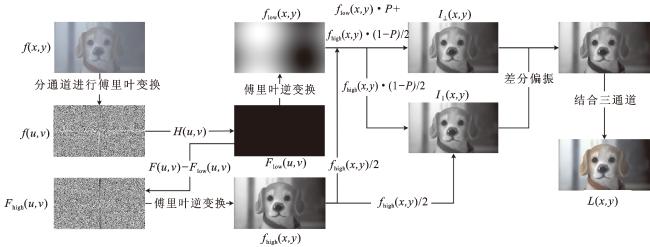
在滤波过程中,需要使单幅散射图像在通过高斯低通滤波器后得到的高频图像能够保留一部分的低频信息,这是因为在非偏振图像的频域中,低频图像中也包含部分的目标信息,因此不能完全舍去低频信息,这样会使得最终结果的保真度大幅下降。对于高斯低通滤波器,本文以0.01为步长分别对高斯低通滤波器的标准差和权重值进行调整,最终得到效果最好的一组标准差为1、权重值为0.55作为滤波器的关键参数。为实现单幅彩色图像的水下伪偏振成像方法,需要对彩色图像的RGB通道分别进行上述操作。为避免RGB通道对最终结合后的图像的影响,对RGB通道进行结合的处理时,需要进行颜色校正,这里通过对RGB 3个通道选择其全局的最大最小值来进行全局的归一化以避免在最终结果中出现色彩的偏差。本方法通过单幅图像的频域处理将图像分为高频和低频分量,分别表示目标信息和背景信息,并利用傅里叶变换和高斯低通滤波器构造出正交偏振图像,从而实现水下伪偏振去散射成像。具体算法流程如图1所示。
2 结果
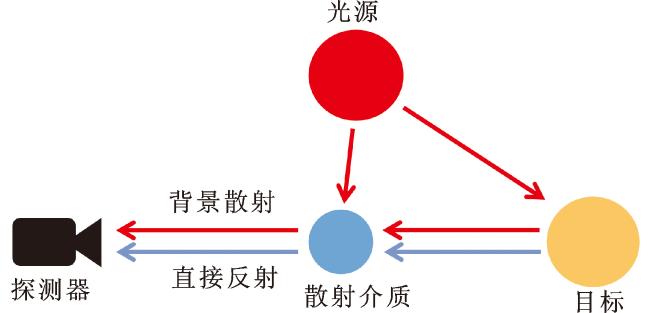
本文所提方法的实验光路示意图如图2所示,主要包括:LED白光光源,探测器(Computar, M2514-MP2),水缸(尺寸:200 cm×60 cm×25 cm),模拟散射介质(脱脂纯牛奶)。实验以目标在含有10 mL脱脂纯牛奶的水下散射环境中距离探测器80 cm的实验结果为例。
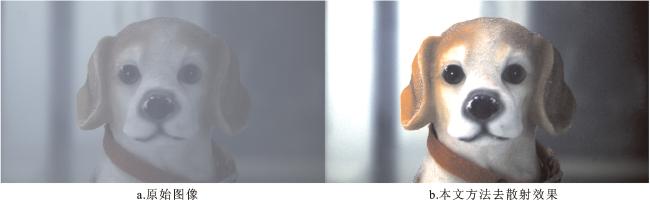
本文所提方法实验结果如图3所示。从图中可以看出,图3b更为清晰,图像对比度明显高于图3a,图像的色彩更加饱满,去除了原图中的散射效应,使物体的真实颜色得以还原。选择3种图像质量评价指标:自然图像质量值(natural image quality evaluator,NIQE)[16]、均方根对比度(root mean square contrast,RMSC)[17]和信息熵(entropy,EN)[18]评价去散射效果。其中,NIQE值是一种无参考图像质量评估方法,它通过统计特征与自然场景统计模型进行比较来评估图像质量,NIQE值越低表示图像质量越高,越接近于自然图像;RMSC用于衡量图像整体的对比度,值越大表示图像对比度越高;信息熵则可反映图像的清晰度、对比度和噪声水平。高质量的图像通常具有较高的信息熵,因为它们包含更多的有用信息和细节。本文所提方法显著提升了图像的信息熵,降低了NIQE值,并在RMSC上有较大提升,验证了方法的有效性(见表1)。
为对比在不同水体环境中本文所提方法的水下去散射效果,在水缸中分别添加10 mL、30 mL、50 mL的脱脂纯牛奶,构造3种不同条件的水下散射环境,同时根据目标物体与探测器的距离,将实验划分为3个不同距离的对比实验。所得实验结果如图4所示。
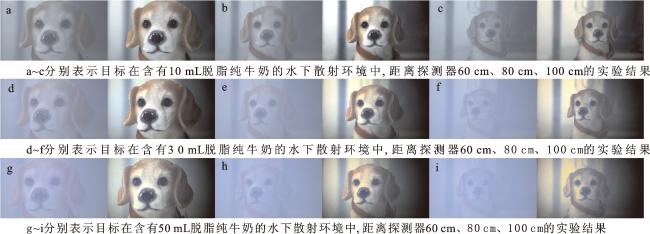

表2 无参考质量评价指标Tab.2 No reference quality evaluation indicators |
| 评价指标 | 原图 | 暗通道 | SSR | MSR | 本文方法 |
|---|---|---|---|---|---|
| NIQE | 5.75 | 4.17 | 2.58 | 3.53 | 2.53 |
| RMSC | 32.579 2 | 30.069 | 61.248 4 | 67.696 3 | 75.756 7 |
| EN | 6.710 6 | 6.185 4 | 7.788 6 | 7.794 1 | 7.735 |
注:黑体代表效果最佳项。 |
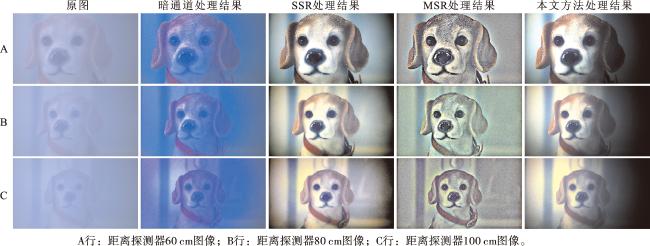
为直观感受不同方法在不同水体环境中的处理效果差异性,分别对含有10 mL、30 mL、50 mL脱脂纯牛奶的不同水体环境中的目标进行了对比实验,并计算出平均无参考平均指标,所得结果如表3所示。
表3 不同环境下平均无参考评价指标Tab.3 Average no-reference evaluation metric under different environments |
| 去散射方法 | 10 mL | 30 mL | 50 mL | ||||||||||||||
|---|---|---|---|---|---|---|---|---|---|---|---|---|---|---|---|---|---|
| NIQE | RMSC | EN | NIQE | RMSC | EN | NIQE | RMSC | EN | |||||||||
| 暗通道 | 4.20 | 31.19 | 6.21 | 4.80 | 32.92 | 6.71 | 4.97 | 30.68 | 6.76 | ||||||||
| SSR | 2.74 | 62.36 | 7.81 | 3.94 | 65.41 | 7.88 | 4.37 | 64.57 | 7.86 | ||||||||
| MSR | 3.90 | 68.01 | 7.80 | 4.90 | 58.67 | 7.73 | 6.16 | 55.37 | 7.74 | ||||||||
| 本文方法 | 2.60 | 84.16 | 7.45 | 2.33 | 85.18 | 7.48 | 2.49 | 82.67 | 7.63 | ||||||||
注:黑体代表不同方法中效果最佳项。 |
从图6以及表3中可以发现,在含有50 mL脱脂纯牛奶的水下强散射环境中,暗通道方法处理的图像色彩与背景近乎融为一体,失去了一些目标原有的色彩信息;SSR方法的主要问题在于不同水体环境和不同成像距离时,背景会产生不一样的色彩偏差;MSR方法则更适用于强散射或远距离水下环境,对弱散射条件或近距离水下散射图像的处理过程会产生较高的噪声。上述实验表明本文所提方法在不同水体环境、不同探测距离情况下都具有较好的图像复原能力且复原图像色彩更真实。此外,通过对4种方法的平均运行时间统计可得,暗通道方法的平均运行时间最短,为0.42 s;SSR方法的平均运行时间最长,达到10.25 s;MSR方法的平均运行时间为4.23 s;而本文方法的平均运行时间为0.73 s。总体来看,本文方法在运行效率上优于SSR和MSR方法,且接近暗通道方法。相较于SSR、MSR等方法,本文所提方法的运行时间更短,体现了其处理速度快的优势。其中,本文实验环境的计算机配置为CPU:13th Gen Intel(R) Core(TM) i5-13500,处理图像的像素分辨率为1 920×1 080。
为验证本文所提方法对细节的恢复能力,替换了纹理和细节信息的军用车模型作为水下目标进行了去散射实验,实验结果如图7所示。
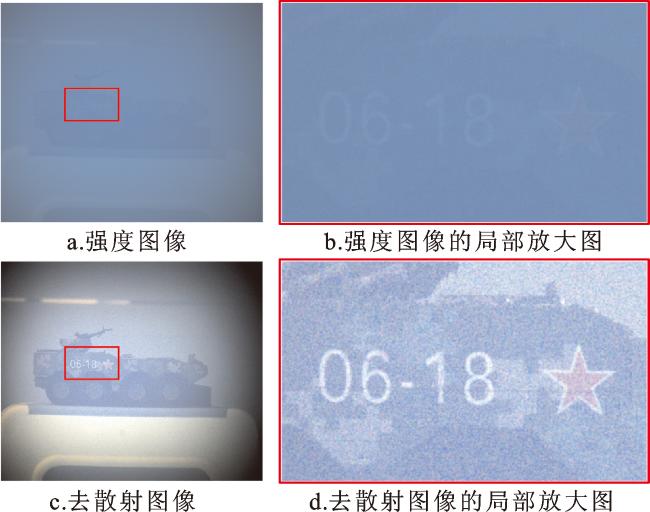


由图7可以看出,本文方法可以得到清晰的水体目标图像,所得结果相较于原始图像在图中红色方框区域部分颜色更清晰、目标的轮毂更明显,目标的细节也更清晰。综上,本文方法在不同浓度的水体和多种距离条件下均能有效去除散射,使得目标轮廓清晰可见,并且色彩接近真实,表明本文方法在复杂水体环境中具有较好的适应性和去散射能力。
3 结论
本文在水下差分偏振成像的基础上,通过对图像频域的研究提出了基于单幅图像的伪偏振水下去散射方法。本文所提方法相较于原始图像去散射效果显著,且在不同浑浊度和距离条件下均表现出良好的适应性。通过与其他方法对比,如暗通道先验、Retinex单尺度和多尺度方法,本文方法在清晰度、对比度及自然度方面均表现出优势。相较于其他单幅图像的水下复原结果,本文所提方法不仅较好地保留了水下差分偏振成像的运行速度快、去散射能力强、目标检测效果好等优势,而且为单幅散射图像开拓了偏振成像的思路,其较快的处理速度也为进行水下去散射实验时提供了方便。为了使该方法更广泛地适用于不同的去散射场景,未来研究可以将该方法拓展至其他复杂环境中,优化算法以便于处理复杂环境下的多目标检测。同时可以将该方法拓展至其他复杂环境中,例如在海上或雾霾天气下的图像去雾、目标检测等方面.