欢迎访问陕西师范大学学报(自然科学版)官方网站!
蛋白特性及生物功能

WRKY转录因子调控植物次生代谢物研究进展

  • 罗贵 1 ,
  • 朱历勇 2 ,
  • 谷雷 1 ,
  • 王洪程 1 ,
  • 杜旭烨 1 ,
  • 朱斌 1 ,
  • 曾拓 , 1, * ,
  • 王彩云 , 2, *
展开
  • 1 贵州师范大学 生命科学学院,贵州 贵阳 550025
  • 2 华中农业大学 园艺林学学院 果蔬园艺作物种质创新与利用全国重点实验室,湖北 武汉 430070
*曾拓,男,副教授,硕士生导师,研究方向为园艺植物分子生物学。E-mail:;
*王彩云,女,教授,博士生导师,研究方向为观赏植株生理与分子生物学。E-mail:

Office editor: 焦阳

收稿日期: 2024-12-14

  网络出版日期: 2025-06-23

基金资助

国家自然科学基金(32160718)

贵州省科技计划一般项目(ZK〔2022〕301)

黔师新苗项目(〔2022〕19)

Research progress on WRKY transcription factors in regulating plant secondary metabolites

  • LUO Gui 1 ,
  • ZHU Liyong 2 ,
  • GU Lei 1 ,
  • WANG Hongcheng 1 ,
  • DU Xuye 1 ,
  • ZHU Bin 1 ,
  • ZENG Tuo , 1, * ,
  • WANG Caiyun , 2, *
Expand
  • 1 School of Life Sciences, Guizhou Normal University, Guiyang 550025, Guizhou, China
  • 2 National Key Laboratory of Germplasm Innovation and Utilization of Fruit and Vegetable Horticultural Crops, College of Horticultural Forestry, Huazhong Agricultural University, Wuhan 430070, Hubei, China

Received date: 2024-12-14

  Online published: 2025-06-23

摘要

植物次生代谢物是植物在生长过程中通过次生代谢途径合成的一类具有生理活性的有机化合物,其并不是植物生长发育的必需成分,但在植物生存、环境适应、抗逆性等方面发挥着关键作用。WRKY转录因子家族因具有特征性的保守核心序列 WRKYGQK结构域而得名,是高等植物中规模最大且功能最为多样化的转录因子家族之一,在植物界广泛分布。WRKY转录因子通过调控次生代谢产物合成参与植物的生长发育、环境应答和化学防御等多种生理过程。文章综述了WRKY转录因子的结构特征与分类,并重点讨论了其在调控植物次生代谢产物(如萜类、酚类和生物碱)合成中的研究进展。未来研究应进一步探索WRKY转录因子在植物次生代谢调控网络中的作用机制,以及在增强植物抗逆性和改良次生代谢产物品质方面的潜在应用,以期为农业生物技术的发展和植物功能性改良提供理论与实践支持。

本文引用格式

罗贵 , 朱历勇 , 谷雷 , 王洪程 , 杜旭烨 , 朱斌 , 曾拓 , 王彩云 . WRKY转录因子调控植物次生代谢物研究进展[J]. 陕西师范大学学报(自然科学版), 2025 , 53(3) : 115 -128 . DOI: 10.15983/j.cnki.jsnu.2025210

Abstract

Plant secondary metabolites are a class of biologically active organic compounds synthesized through secondary metabolic pathways during plant growth. These compounds are not essential for plant development but play crucial roles in many aspects including plant survival, environmental adaptation and stress resistance. The WRKY transcription factor family, named for its characteristic conserved WRKYGQK domain, is one of the largest and most functionally diverse transcription factor families in higher plants. These factors are widely distributed across the plant kingdom and regulate the synthesis of secondary metabolites, thus participating in various physiological processes including plant growth, environmental responses, and chemical defense. This review discusses the structural features and classification of WRKY transcription factors, with a focus on their role in regulating the synthesis of plant secondary metabolites such as terpenes, phenolics and alkaloids. Future research should delve deeper into the mechanisms by which WRKY transcription factors function within the plant secondary metabolism regulatory network and their potential applications in enhancing plant stress resistance and improving the quality of secondary metabolites. Such studies will provide theoretical and practical insights for the advancement of agricultural biotechnology and the functional improvement of plants.

转录因子(transcription factors,TFs)也称为反式作用因子,是一类特殊的蛋白质,能够调控基因转录过程[1]。它们通过结合DNA上的特定序列(通常是启动子或增强子区域)影响RNA聚合酶的招募及活性,进而调控目标基因的表达水平和模式[2]。转录因子根据其分子结构特征可分为多个家族,如WRKY、MYB、bHLH、NAC、bZIP等。其中,WRKY转录因子是植物中规模最大、功能最多样化的转录因子家族之一[3],广泛参与植物生长发育和对环境变化的响应[4]。WRKY转录因子通常与靶基因启动子中的W-box互作,激活或抑制下游基因的表达,从而在多种生理过程中发挥关键作用[5]
植物次生代谢物(plant secondary metabolites,PSMs)是植物在生长过程中通过次生代谢途径合成的一类具有生理活性的有机化合物[6]。与植物生长必需的基本成分如氨基酸和碳水化合物(即初级代谢物)不同,次生代谢物是由初级代谢物经过修饰(如甲基化、羟基化、糖基化)形成的,通常并不是植物生存所必需的[7]。PSMs在植物防御系统中起着至关重要的作用,保护植物免受生物和非生物胁迫,如感染、物理伤害、紫外线照射和臭氧侵害等,帮助植物适应不断变化的环境[8]。此外,PSMs还能抵御食草动物的侵害,并在化学、制药、化妆品和香料行业中应用广泛[9];某些PSMs还具有抗癌、抗氧化、抗病毒、抗炎等活性[10]。PSMs主要分为三大类:萜类、酚类及含氮含硫化合物,转录因子在PSMs合成中具有关键调控作用[11]
WRKY转录因子家族在植物中的功能多样性已被广泛研究,尤其是在调节植物生长发育方面,但WRKY转录因子家族如何精确调控植物次生代谢物的生物合成仍有待深入研究。因此,本综述旨在综合现有的研究成果,阐明WRKY转录因子对植物次生代谢物调控的影响,提供WRKY转录因子在次生代谢物合成调控中的作用概览,为植物次生代谢物代谢工程提供可能的应用方向。

1 WRKY转录因子的结构与分类

WRKY转录因子是调控植物生长发育和响应环境变化的关键因子[12]。WRKY蛋白以1个或2个高度保守的WRKY结构域为特征,大多数WRKY蛋白至少包含1个由约60个氨基酸残基组成的WRKY结构域[13]。WRKY结构域包含2个重要序列,即N端高度保守的七肽序列WRKYGQK(存在变体如WRKYGKK、WRKYGEK等)和C端的金属螯合锌指基序[14-15]。 WRKYGQK序列负责与W-box序列结合,W-box是WRKY转录因子与靶基因启动子特异性结合的重要顺式作用元件,主要存在于抗病虫害、抗旱、抗低温、抗盐碱等相关抗性基因的启动子区域,W-box的核心序列(TGAC/T)是WRKY转录因子结合所必需的,因此WRKY转录因子在植物应对生物和非生物胁迫方面发挥着重要作用[16-17]。C端锌指基序通常为C2H2(CX4-5CX22-23HX1H)型或C2HC(CX7CX23HXC)型,这些结构在WRKY转录因子与DNA的结合过程中起着稳定结构的作用,并有助于增强WRKY转录因子与DNA的亲和力,对WRKY转录因子的功能发挥至关重要[18-20]。在植物进化过程中及不同植物之间,WRKY基因的数量、内含子数目和核苷酸序列都表现出显著差异[2,21]
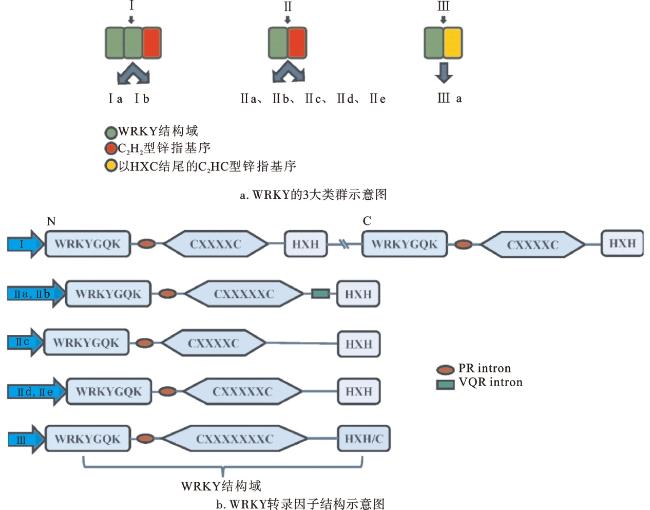
根据WRKY结构域的数量和锌指结构的类型,WRKY转录因子可分为3个主要类群(Ⅰ、Ⅱ、Ⅲ,图1a),并可进一步细分为8个亚类[22-23]。类群Ⅰ包含2个WRKY结构域和1个C2H2型锌指基序,主要由C端的WRKY结构域参与DNA结合,而N端WRKY结构域的功能和作用还未得到充分证实。值得注意的是,类群Ⅰ的2个WRKY结构域在功能上可能存在冗余,且其C端WRKY结构域与类群Ⅱ、Ⅲ的WRKY结构域在序列上更为相似,可能构成了主要的DNA结合域。类群Ⅱ包含1个WRKY结构域和1个C2H2型锌指基序,并可进一步细分为5个亚群(Ⅱa~Ⅱe)。类群Ⅲ则包含1个WRKY结构域和1个以HXC结尾的C2HC型锌指基序(图1b)。3个类群WRKY转录因子的具体功能因植物种类和生长环境的不同而有所差异[14]
图1 WRKY转录因子的分类与结构

注:网络版为彩图。

Fig.1 Classification and structure of WRKY transcription factors

2 WRKY转录因子在植物中的功能

植物在整个发育过程中会不可避免地受到各种生物和非生物胁迫[24]。研究表明,WRKY转录因子在植物应激反应及发育过程中起到关键作用。它们通过调控相关基因的表达增强植物抗逆性,为植物生长发育提供保障,尤其是在激素信号传导方面,如脱落酸(abscisic acid,ABA)、水杨酸(salicylic acid,SA)、茉莉酸(jasmonic acid,JA)等[21-25],WRKY转录因子通过调控下游基因的表达来促进或抑制相关蛋白的合成[5]。在生物胁迫和非生物胁迫过程中,WRKY转录因子可作为正调节剂或负调节剂,通过调节相关基因表达来影响植物对胁迫的耐受性。例如,在拟南芥(Arabidopsis thaliana)中,WRKY57WRKY63基因过表达会显著提高植株抗旱性,与野生型相比,过表达植株体内的ABA含量增加,同时抵抗胁迫的相关基因表达也上调[26];大蒜(Allium sativum)中的9个AsWRKYs对盐胁迫、赤霉素胁迫和干旱胁迫均有响应[27];在药用稻(Oryza officinalis)中,OsWRKY3OsWRKY13等转录因子可以被病原菌诱导表达,并通过调节相关基因表达参与植物的防御反应[28]。随着研究的深入,不断有新的WRKY转录因子在植物中被鉴定和分析,其功能多样性也逐渐得到阐明[29]。WRKY转录因子在不同植物中的功能预测列于表1
表1 不同植物中WRKY转录因子的功能预测

Tab.1 Functional prediction of WRKY transcription factors in different plants

物种 鉴定数 功能预测 相应WRKY转录因子
大蒜(Allium sativum)[27] 78 高温和高盐胁迫响应 As29182、As40049、As20748、As31693、As36680、As38227、As39900、As46742、As91121
高粱(Sorghum bicolor)[26] 94 抗干旱和保持绿色 SbWRKY45、SbWRKY79、SbWRKY74、
SbWRKY72、SbWRKY75
拟南芥(Arabidopsis thaliana)[26] 74 抗干旱和抗渗透胁迫 AtWRKY63、AtWRKY57、AtWRKY54
茄子(Solanum melongena)[19] 50 参与非生物和生物胁迫、病原菌抗性 Smel_Unigene_26604_orf
水茄(Solanum torvum)[19] 62 参与非生物和生物胁迫、病原菌抗性 Stor_Unigene_36980_orf
甘蓝(Brassica oleracea)[30] 148 抗逆、参与植物生长和形态发育 BolWRKY61、BolWRKY67、BolWRKY83、
BolWRKY84、BolWRKY119、BolWRKY122、
BolWRKY117
小麦(Triticum aestivum)[31] 172 热胁迫和干旱胁迫响应 TaWRKY014、TaWRKY090、TaWRKY008、
TaWRKY122
闽楠(Phoebe bournei)[32] 60 抗干旱和涝渍 PbWRKY36
玉米(Zea mays)[33] 106 高温胁迫和干旱胁迫响应、ABA信号 ZmWRKY106
甜橙(Citrus sinensis)[34] 47 抗指状青霉感染 CsWRKY2、CsWRKY14
陆地棉(Gossypium hirsutum)[35] 15 参与生长发育和叶片衰老 GhWRKY17
药用野生稻(Oryza officinalis Wall)[28] 89 参与生长发育、抗细菌和真菌 OoWRKY13、OoWRKY71、OoWRKY111、
OoWRKY26、OoWRKY53、OoWRKY30、
OoWRKY3、OoWRKY13
甘蔗(Saccharum spontaneum)[36] 154 参与糖代谢和光合作用 SsWRKY71、SsWRKY145、SsWRKY68、
SsWRKY122、SsWRKY125、SsWRKY21、
SsWRKY22、SsWRKY39、SsWRKY56
马褂木(Liriodendron
chinense)[37]
44 低温、高温和干旱胁迫响应 LchiWRKY5、LchiWRKY23、LchiWRKY14、LchiWRKY27、LchiWRKY36
亚麻(Linum usitatissimum)[38] 105 参与生长发育和逆境应答 Lus10001265、Lus10012215、Lus10042243、
Lus10026409、Lus10002309、Lus10024074、
Lus10026082
芹菜(Apium graveolens)[39] 69 抗低温和干旱胁迫 AgWRKY50、AgWRKY39、AgWRKY47、
AgWRKY71、AgWRKY8、AgWRKY2、AgWRKY38
文冠果(Xanthoceras sorbifolium)[40] 65 响应盐胁迫和干旱胁迫以及激素处理 XsWRKY20、XsWRKY34
莲花(Nelumbo nucifera)[41] 65 参与生物和非生物胁迫、提高苯基异喹啉生物碱合成 NnWRKY40a、NnWRKY40b
甘薯(Ipomoea batatas)[42] 79 增强盐胁迫耐受性 IbWRKY47、IbWRKY33
菜豆(Phaseolus vulgaris)[43] 88 干旱胁迫响应 PvWRKY1、PvWRKY2、PvWRKY3、PvWRKY5、
PvWRKY21、PvWRKY24、PvWRKY28、
PvWRKY38、PvWRKY40、PvWRKY52、
PvWRKY53、PvWRKY43、PvWRKY58
半夏(Pinellia ternata)[44] - 高温胁迫响应 PtWRKY2
表1可以看出,WRKY转录因子在植物中扮演着多样化的角色,它们不仅通过调控激素信号传导影响植物的生长发育和逆境响应,还参与其他生理过程。WRKY转录因子调控的植物次生代谢物包括萜类、酚类和生物碱等多种化合物,这些代谢物在植物适应环境和抵御胁迫方面发挥着极其重要的作用。
为了探究不同物种之间WRKY家族基因的系统发育和进化关系,采用MAFFT软件对拟南芥、高粱和水稻的WRKY编码氨基酸序列进行比对,利用MEGA 11.0 软件构建系统发育树(图2)。结果表明:拟南芥中参与干旱和渗透胁迫调控的AtWRKY57属于Ⅲ组,而AtWRKY63AtWRKY54属于Ⅱd亚组,参与脱落酸信号传导和非生物胁迫的AtWRKY8AtWRKY50属于Ⅲ组[26];水稻中与病原菌抗性相关的OsWRKY3位于Ⅱb亚组,而激活类黄酮生物合成的OsWRKY13则属于Ⅱe亚组[28];高粱中抗干旱的SbWRKY45位于Ⅰ组,SbWRKY74归属于Ⅱc亚组,SbWRKY75位于Ⅱe亚组,而SbWRKY79SbWRKY72均属于Ⅲ组,可以调节脱落酸的SbWRKY8位于Ⅱc亚组,SbWRKY45位于Ⅰ组[26]。可以发现,调节植物的WRKY转录因子在WRKY基因家族的3个类群中均有分布。这些结果表明,与代谢和抗逆性相关的WRKY转录因子并未严格分布于WRKY基因家族的特定类群,而是广泛存在于不同类群中,反映了WRKY基因在不同物种间的进化多样性与功能复杂性。
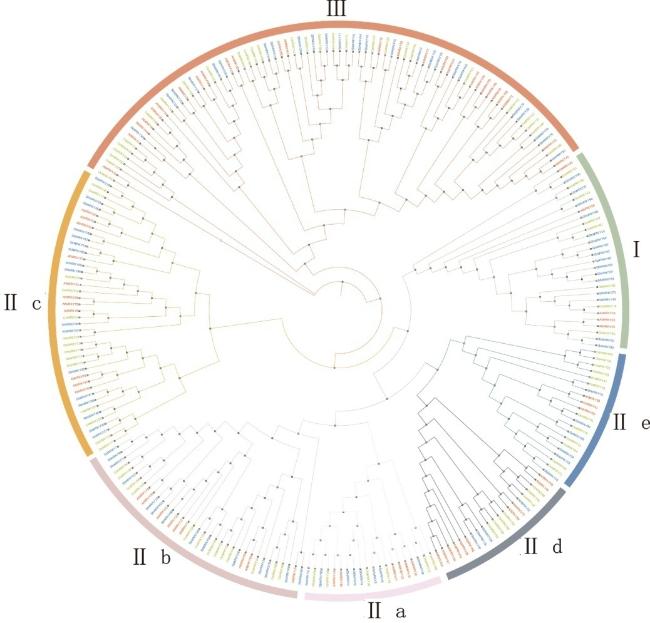
图2 植物WRKY家族基因系统发育树

注:WRKY家族基因主要分为Ⅰ、Ⅱ、Ⅲ组。AtWRKYsOsWRKYsSbWRKYs分别用红色、绿色和蓝色表示。网络版为彩图。

Fig.2 Phylogenetic tree of plant WRKY family genes

3 WRKY转录因子在植物次生代谢过程中的调控作用

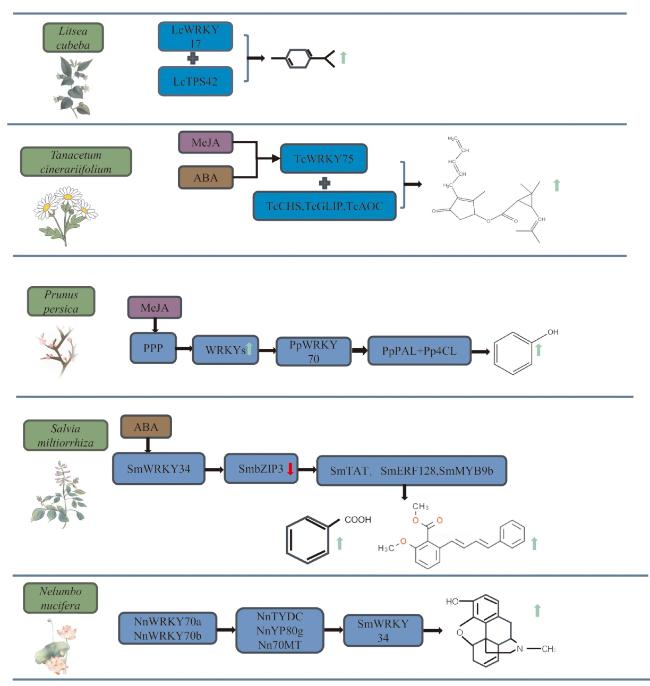
植物在长期进化过程中形成了一系列适应性产物,即次生代谢物,包括萜类、酚类和生物碱等,这些化合物在植物应对非生物胁迫(例如干旱胁迫、高温胁迫、低温胁迫、盐胁迫)和生物胁迫(例如病原菌感染和植食性昆虫侵害)中扮演着至关重要的角色。萜类化合物不仅参与胁迫信号的传递,还会吸引授粉者、捕食者和寄生性天敌[45]。酚类化合物(如多酚和黄酮类)具有强抗氧化能力,可有效清除活性氧,维持细胞内氧化还原平衡。此外,某些酚类代谢物还能抑制病原菌的酶活性并阻止其侵染[46]。生物碱类次生代谢物具有广泛的抗菌、抗病毒和抑制昆虫活性等功能。这些次生代谢物的合成和积累受到精细调控,其中转录因子扮演着关键角色。WRKY转录因子作为植物特异性转录调控网络的核心组成部分,在调控次生代谢途径中具有重要作用。不同植物的WRKY家族成员在次生代谢途径中的功能存在显著差异,这种调控多样性反映了WRKY家族成员的功能特异性及其在不同环境条件下的适应性(表2,图3)。
表2 WRKY转录因子参与的次生代谢物生物合成调控

Tab.2 Biosynthesis regulation of secondary metabolites involved by WRKY transcription factors

物种 WRKY转录因子 次生代谢物 转录因子对次生代
谢物合成的作用
WRKY转录因子
的作用位点
砂仁(Amomum villosum)[47] AvWRKY61、AvWRKY28、AvWRKY40 萜烯 促进 AvNeoD
山鸡椒(Litsea cubeba)[48] LcWRKY17 单萜类 促进 LcTPS42
丹参(Salvia miltiorrhiza)[49] SmWRKY1、SmWRKY7、SmWRKY19、SmWRKY29、SmWRKY45、SmWRKY52、SmWRKY56、SmWRKY58、SmWRKY68 丹参酮、酚酸 促进 SmDXS2、SmGGPPS、
SmCPS、SmKSL、
SmCYP76H1
番茄(Solanum lycopersicum)[50] SlWRKY4、SlWRKY31、SlWRKY37 总酚、类黄酮 促进 β-葡聚糖酶A、防御素、几丁质酶
葡萄(Vitis vinifera)[51] VvWRKY8 白藜芦醇 抑制 VvSTS15、VvSTS21
小蛇根草(Ophiorrhiza pumila)[52] OpWRKY2 喜树碱 促进 OpTDC
苹果(Malus domestica)[53] MdWRKY75、MdWRKY1 花青素 促进 MdLNC499、MdERF109
马铃薯(Solanum tuberosum)[54] StWRKY70 花青素 促进 StDFR、StAN1
红豆杉(Taxus chinensis)[55] TcWRKY33 紫杉醇 促进 TcDBAT、TcTASY
青蒿(Artemisia annua)[56] AaWRKY9 青蒿素 促进 AaDBR2、AaGSW1
烟草(Nicotiana tabacum)[57] NtWRKY3 东莨菪碱、小檗碱 促进 NtLOX3、NtACS1、NtACO1
桔梗(Platycodon gran-
diflorus)[58]
PgWRKY2、PgWRKY9、PgWRKY10、PgWRKY24 三萜皂苷 促进 PgHMGS、PgHMGR、PgMK、PgMVD
桃树(Prunus persica)[59] PpWRKY70 绿原酸 促进 PpPAL、Pp4CL
啤酒花(Humulus lupulus)[60] HlWRKY1 异戊烯基黄酮 促进 HlWDR1
灯盏花(Erigeron breviscapus)[61] EbWRKY11、EbWRKY36、
EbWRKY44
黄酮类化合物 促进 EbF6H
百香果(Passiflora edulis)[62] PeWRKY48 黄酮类化合物 促进 PeF3H、PeCHI
除虫菊(Tanacetum cinerariifolium)[63] TcWRKY75 除虫菊酯 促进 TcCHS、TcAOC、TcGLIP
图3 WRKY转录因子对植物次生代谢物的调控

注:网络版为彩图。

Fig.3 Regulation of WRKY transcription factors on plant secondary metabolites

3.1 WRKY对植物萜类化合物合成的影响

萜类也被称为类异戊二烯,是由异戊二烯单元衍生而成的一类极为丰富的天然产物。根据异戊二烯单元的数量,萜类可分为单萜、倍半萜、二萜、三萜及多萜[64-66]。迄今为止,已鉴定的萜类化合物超过8万种,它们在医疗、环保和食品等领域扮演着多重角色,包括药用、植保防控、食品保鲜等。例如,萜类化合物可作为化感物质调节植物生长,增强植物的抗病能力,或通过抑制病原微生物的生长提高植物免疫力。萜类用于食品中的致病菌防治,可延长食品保鲜期[67-68]。萜类化合物的生物合成主要涉及2条代谢途径,即甲羟戊酸(mevalonate,MVA)途径和甲基赤藓糖醇磷酸(methylerythritol phosphate,MEP) 途径,分别在细胞质和过氧化物酶体及质体中进行[69-71]
近年来,研究证明了WRKY转录因子在植物萜类合成中的重要作用。例如,山苍子中的64个WRKY基因分布于12条染色体上,其中LcWRKY17特异性调控单萜类化合物的合成。通过双荧光素酶和酵母单杂交分析,证实LcWRKY17通过结合LcTPS42启动子的W-box元件激活其转录,从而促进单萜合成[46]。除虫菊以其产生的具有杀虫作用的单萜衍生物除虫菊酯著称[72-73],其腺体定位、响应茉莉酸甲酯(methyl jasmonate,MeJA)处理的TcWRKY75转录因子能够通过结合除虫菊酯合成基因TcCHSTcGLIP以及 TcAOC启动子的W-box元件,促进除虫菊酯的合成与积累[63]。黄花蒿全基因组分析鉴定出122个WRKY基因,其中AaWRKY40启动子区包含多个非生物胁迫顺式调控元件,AaWRKY40AaWRKY1在茉莉酸甲酯处理的黄花蒿细胞培养物中的表达分析结果表明,AaWRKY40可能参与青蒿素的合成[74]。人参中的PgWRKY4X能够与角鲨烯环氧化酶启动子结合,提高人参皂苷生物合成相关基因的表达,促进人参皂苷积累[75]。西洋参中的PqWRKY1在拟南芥中异源过表达能够激活三萜生物合成途径[76];在桔梗中,PgWRKY2PgWRKY9PgWRKY10PgWRKY24这4个转录因子与三萜生物合成途径基因正相关,这些基因分布在系统发育类群Ⅰ和Ⅱ中,这与西洋参中的研究结果一致[58]。在香椿(Toona sinensis)中,共表达网络分析揭示了78个TsWRKY基因中的多个成员与10个萜烯合成基因的表达高度相关,尤其是TsFPPSTsIDITsMTPS等,TsWRKY9TsWRKY24TsWRKY35可能协同调节萜烯合成[77]

3.2 WRKY对植物酚类化合物合成的影响

酚类化合物是植物次生代谢物的重要组成部分,在植物抵抗胁迫中起着重要作用[78]。在植物适应环境胁迫的过程中,酚类化合物的含量会显著增加,以增强其防御机制[79-80]。迄今为止,从天然来源产物中已鉴定出8 000多种酚类物质,主要包括总酚类、可溶性黄酮醇类、花青素类、酚酸类等[81-82]。这些化合物作为植物内在生理调节剂,对植物生长至关重要,它们的π键能吸收对细胞有害的高能波长,保护植物免受伤害[83]
研究表明,WRKY转录因子在植物酚类次生代谢物的合成和调节中起重要作用,这些转录因子通过激活与抗逆相关的代谢途径来影响植物中的酚类物质含量。例如,在小麦中8个TaWRKY基因在盐胁迫下表现出显著诱导作用,尤其是TaWRKY6的表达量在Sids 14Sakha 93中急剧增加,同时小麦中的总糖、脯氨酸和酚类物质含量显著升高[84]。MeJA通过调控苯丙烷途径,启动桃树根霉防御的分子机制,特别是通过启动PpWRKY70表达,激活PpPALPp4CL启动子,提高这些酶的活性及总酚类、总黄酮的含量,从而增强植株抗病性,降低病害发生率[59]。在高温胁迫下,4个莴苣品种中鉴定到大量与类黄酮生物合成相关的代谢物和差异表达基因,此外,鉴定的31个转录因子中有25个上调,其中WRKY转录因子在类黄酮合成中起到重要作用[52]。蒲公英(Taraxacum antungense)中含有的木犀草素是蒲公英的主要次生代谢物,它是一种低分子量的多酚类化合物,TaWRKY44基因表达上调时,蒲公英中木犀草素的含量增加[85]。在黄芩(Scutellaria baicalensis)中,WRKY转录因子在干旱胁迫下的表达调控呈现复杂模式,在中度干旱胁迫下,与黄芩苷合成密切相关的某些WRKY转录因子(如SbWRKY8SbWRKY16)表达显著上调,促进黄芩苷合成;而在严重干旱胁迫下,WRKY家族中部分成员的表达显著降低,黄芩苷的合成也受到抑制[86]。在丹参中,SmWRKY34通过直接调控关键基因,如SmRASSmGGPPS,以及通过ABA响应性的bZIP转录因子SmbZIP3,调节丹参酮和酚酸的合成[87]

3.3 WRKY对植物生物碱合成的影响

生物碱是一类在植物界中广泛存在的含氮有机化合物,并以其复杂的化学结构和显著的生物活性而闻名[88]。在制药工业中,含氮生物碱因其独特的生理活性而被广泛应用于药物开发[89-91],特别是杂环生物碱,因其具有抑制细菌、真菌、原生动物等活性,在药用领域占有重要地位[92]。传统上,生物碱根据其含氮部分的化学结构进行分类,如有机胺类、吡啶类、吲哚类、异喹啉类等,然而由于这些次生代谢物结构的复杂性,分类标准并非总是统一的。通常,这些天然含氮碱基通过多步骤的复杂生物合成途径生成[93]
生物碱的合成和调控同样受到WRKY转录因子的影响。例如,在黄连(Coptis chinensis)中,鉴定出 41个与原小檗碱生物合成相关的 WRKY 转录因子,基于基因表达模式、代谢途径、系统发育和双荧光素酶分析,发现CcWRKY7CcWRKY29CcWRKY32能够调控原小檗碱的生物合成[94]。日本海棠(Chaenomeles japonica)中的CjWRKY1被认为是苯甲基异喹啉生物碱(benzylisoquinoline alkaloid,BIA)合成途径中的关键转录因子,其在花菱草(Eschscholzia californica)中的过表达可上调多种BIA合成酶基因的表达,并提高BIA的积累[95]。在花菱草中,鉴定出50个EcWRKY基因,部分EcWRKY基因能够响应MeJA,且这些基因的表达模式与BIA生物合成酶基因的表达模式相似,可能在BIA合成中发挥作用[96]。在荷花(Nelumbo nucifera)中,NnWRKY70b通过激活包括NnTYDCNnYP80gNn7OMT在内的BIA合成基因启动子,促进BIA积累;而NnWRKY70a仅能够激活NnTYDC的启动子。瞬时过表达实验表明,NnWRKY70aNnWRKY70b显著提高了BIA在莲花花瓣中的积累,其中NnWRKY70b的调控作用更强[97]。在马铃薯(Solanum tuberosum)中,StWRKY8对BIA的合成起正调控作用,特别是在抗病基因型中,StWRKY8与BIA生物合成基因的启动子结合,促进抗菌化合物积累,并增强细胞壁的防御作用[98]。在小蛇根草(Ophiorrhiza pumila)中鉴定出46个OpWRKY基因,这些基因不均匀分布于11条染色体上。过表达OpWRKY6会显著减少喜树碱的积累,而OpWRKY6敲除则可以显著增加喜树碱含量。OpWRKY6通过直接下调OpGESOp10HGOOp7DLHOpTDC基因的表达,负向调控喜树碱的生物合成[99]。在短小蛇根草(Ophiorrhiza pumila)中,OpWRKY1主要在茎中表达,过表达OpWRKY1可抑制喜树碱合成相关基因如OpCPR的表达,显著减少喜树碱积累[100]。在长春花(Catharanthus roseus)中,CrWRKY1受到茉莉酸、赤霉酸和乙烯的诱导,优先在根中表达。CrWRKY1通过与色胺脱羧酶(tryptophan decarboxylase,TDC)启动子中的W-box结合,促进TDC表达并增加色胺浓度,从而提高吲哚生物碱类化合物的积累[101]

4 结论

尽管WRKY转录因子在调控植物次生代谢途径中的作用已被广泛研究,但现有研究多集中于特定的几种模式植物和有限的次生代谢物,缺乏广泛的物种覆盖和系统深入的功能解析,这限制了对WRKY转录因子在广泛植物物种中作用的全面理解。此外,现有研究往往侧重于WRKY家族中的某一种或少数成员,忽视了其他成员的可能作用及成员间的相互作用,详细的分子机制和调控网络尚未完全建立,导致对WRKY转录因子家族功能的认识还不够全面。同时,WRKY转录因子家族与其他转录因子如MYB、bHLH等的相互作用及其在复杂生理和代谢过程中的角色也尚未充分阐明。
未来研究可考虑利用高通量组学技术、生物信息学方法以及CRISPR等基因编辑工具,全面系统解析WRKY家族成员的功能及其在多物种中的作用,包括它们如何通过与其他转录因子及信号分子的交互作用来调控植物次生代谢物的合成。通过现代分子生物学技术,揭示WRKY转录因子在非模式植物中的功能,探索其调控网络和作用机制,揭示其在植物次生代谢物合成中的具体作用。此外,应注重WRKY转录因子在特定组织或发育阶段的表达调控研究,以精确平衡植物生长与次生代谢物积累之间的关系。利用上述深入研究,不仅能够更全面地理解WRKY转录因子在植物次生代谢中的调控机制,还能开发新策略,利用分子育种或基因工程手段提高作物的次生代谢物合成和抗逆性,显著优化植物的农艺性状和经济价值,为食品安全和可持续农业生产提供坚实的科学基础。
[1]
DENG C, WU Y K, LV X Q, et al. Refactoring transcription factors for metabolic engineering[J]. Biotechnology Advances, 2022,57:107935.

[2]
WANI S H, ANAND S, SINGH B, et al. WRKY transcription factors and plant defense responses:latest discoveries and future prospects[J]. Plant Cell Reports, 2021, 40(7):1071-1085.

[3]
LU Z G, WANG X W, MOSTAFA S, et al. WRKY transcription factors in Jasminum sambac:an insight into the regulation of aroma synthesis[J]. Biomolecules, 2023, 13(12):1679.

[4]
VODIASOVA E, SINCHENKO A, KHVATKOV P, et al. Genome-wide identification,characterisation,and evolution of the transcription factor WRKY in grapevine (Vitis vinifera):new view and update[J]. International Journal of Molecular Sciences, 2024, 25(11):6241.

[5]
WANG H L, CHENG X, YIN D M, et al. Advances in the research on plant WRKY transcription factors responsive to external stresses[J]. Current Issues in Molecular Biology, 2023, 45(4):2861-2880.

DOI PMID

[6]
BONT Z, ZÜST T, ARCE C C M, et al. Heritable variation in root secondary metabolites is associated with recent climate[J]. Journal of Ecology, 2020, 108(6):2611-2624.

[7]
ERB M, KLIEBENSTEIN D J. Plant secondary metabolites as defenses,regulators,and primary metabolites:the blurred functional trichotomy[J]. Plant Physiology, 2020, 184(1):39-52.

[8]
JAMWAL K, BHATTACHARYA S, PURI S. Plant growth regulator mediated consequences of secondary metabolites in medicinal plants[J]. Journal of Applied Research on Medicinal and Aromatic Plants, 2018,9:26-38.

[9]
LI C H, JIANG R, WANG X X, et al. Feedback regulation of plant secondary metabolism:applications and challenges[J]. Plant Science:an International Journal of Experimental Plant Biology, 2024,340:111983.

[10]
XUE Y, HE Q F. Cyanobacteria as cell factories to produce plant secondary metabolites[J]. Frontiers in Bioengineering and Biotechnology, 2015, 3(1):57.

[11]
MISHRA A, CHOI S, BAEK1 K. Application of ultraviolet C irradiation for the increased production of secondary metabolites in plants[J]. The Journal of Animal and Plant Sciences, 2020, 30(5):1082-1091.

[12]
SONG H, DUAN Z Q, ZHANG J C. WRKY transcription factors modulate flowering time and response to environmental changes[J]. Plant Physiology and Biochemistry:PPB, 2024,210:108630.

[13]
YANG S, CAI W W, SHEN L, et al. A CaCDPK29-CaWRKY27b module promotes CaWRKY40-mediated thermotolerance and immunity to Ralstonia solanacearum in pepper[J]. New Phytologist, 2022, 233(4):1843-1863.

[14]
BAO F, DING A Q, CHENG T R, et al. Genome-wide analysis of members of the WRKY gene family and their cold stress response in Prunus mume[J]. Genes, 2019, 10(11):911.

[15]
WANG F Q, LI X R, ZUO X, et al. Transcriptome-wide identification of WRKY transcription factor and functional characterization of RgWRKY37 involved in acteoside biosynthesis in Rehmannia glutinosa[J]. Frontiers in Plant Science, 2021,12:739853.

[16]
GUO H Y, ZHANG Y T, WANG Z, et al. Genome-wide identification of WRKY transcription factors in the asteranae[J]. Plants, 2019, 8(10):393.

[17]
KAN J H, GAO G Q, HE Q, et al. Genome-wide characterization of WRKY transcription factors revealed gene duplication and diversification in populations of wild to domesticated barley[J]. International Journal of Molecular Sciences, 2021, 22(10):5354.

[18]
HUANG S Z, HU L J, ZHANG S H, et al. Rice OsWRKY50 mediates ABA-dependent seed germination and seedling growth,and ABA-independent salt stress tolerance[J]. International Journal of Molecular Sciences, 2021, 22(16):8625.

[19]
YANG X, DENG C, ZHANG Y, et al. The WRKY transcription factor genes in eggplant (Solanum melongena L.) and Turkey Berry (Solanum torvum Sw.)[J]. International Journal of Molecular Sciences, 2015, 16(4):7608-7626.

[20]
WANG L J, GUO D Z, ZHAO G D, et al. Group Ⅱc WRKY transcription factors regulate cotton resistance to Fusarium oxysporum by promoting GhMKK2-mediated flavonoid biosynthesis[J]. New Phytologist, 2022, 236(1):249-265.

[21]
LI W X, PANG S Y, LU Z G, et al. Function and mechanism of WRKY transcription factors in abiotic stress responses of plants[J]. Plants, 2020, 9(11):1515.

[22]
CHEN C H, CHEN X Q, HAN J, et al. Genome-wide analysis of the WRKY gene family in the cucumber genome and transcriptome-wide identification of WRKY transcription factors that respond to biotic and abiotic stresses[J]. BMC Plant Biology, 2020, 20(1):443.

[23]
WU W H, YANG J C, YU N, et al. Evolution of the WRKY family in angiosperms and functional diversity under environmental stress[J]. International Journal of Molecular Sciences, 2024, 25(6):3551.

[24]
MA Z M, HU L J. WRKY transcription factor responses and tolerance to abiotic stresses in plants[J]. International Journal of Molecular Sciences, 2024, 25(13):6845.

[25]
GOYAL P, DEVI R, VERMA B, et al. WRKY transcription factors:evolution,regulation,and functional diversity in plants[J]. Protoplasma, 2023, 260(2):331-348.

[26]
BAILLO E H, HANIF M S, GUO Y H, et al. Genome-wide identification of WRKY transcription factor family members in Sorghum (Sorghum bicolor(L.) moench)[J]. PLoS One, 2020, 15(8):e0236651.

[27]
YANG Q Q, YANG F, ZHAO Y Q, et al. Genome-wide identification and functional characterization of WRKY transcription factors involved in the response to salt and heat stress in garlic (Allium sativum L)[J]. Biotechnology & Biotechnological Equipment, 2021, 35(1):1956-1966.

[28]
JIANG C M, SHEN Q J, WANG B, et al. Transcriptome analysis of WRKY gene family in Oryza officinalis Wall ex Watt and WRKY genes involved in responses to Xanthomonas oryzae pv.oryzae stress[J]. PLoS One, 2017, 12(11):e0188742.

[29]
SONG H, CAO Y P, ZHAO L G, et al. Review:WRKY transcription factors:understanding the functional divergence[J]. Plant Science:an International Journal of Experimental Plant Biology, 2023,334:111770.

[30]
YAO Q Y, XIA E H, LIU F H, et al. Genome-wide identification and comparative expression analysis reveal a rapid expansion and functional divergence of duplicated genes in the WRKY gene family of cabbage,Brassica oleracea var.capitata[J]. Gene, 2015, 557(1):35-42.

[31]
GUPTA S, MISHRA V K, KUMARI S, et al. Deciphering genome-wide WRKY gene family of Triticum aestivum L.and their functional role in response to abiotic stress[J]. Genes & Genomics, 2019, 41(1):79-94.

[32]
WANG Z X, YOU L M, GONG N, et al. Comprehensive expression analysis of the WRKY gene family in Phoebe bournei under drought and waterlogging stresses[J]. International Journal of Molecular Sciences, 2024, 25(13):7280.

[33]
WANG C T, RU J N, LIU Y W, et al. Maize WRKY transcription factor ZmWRKY106 confers drought and heat tolerance in transgenic plants[J]. International Journal of Molecular Sciences, 2018, 19(10):3046.

[34]
XI D X, YIN T, HAN P C, et al. Genome-wide identification of sweet orange WRKY transcription factors and analysis of their expression in response to infection by Penicillium digitatum[J]. Current Issues in Molecular Biology, 2023, 45(2):1250-1271.

[35]
GU L J, LI L B, WEI H L, et al. Identification of the group Ⅱa WRKY subfamily and the functional analysis of GhWRKY17 in upland cotton (Gossypium hirsutum L.)[J]. PLoS One, 2018, 13(1):e0191681.

[36]
LI Z, HUA X T, ZHONG W M, et al. Genome-wide identification and expression profile analysis of WRKY family genes in the autopolyploid Saccharum spontaneum[J]. Plant and Cell Physiology, 2020, 61(3):616-630.

[37]
WU W H, ZHU S, XU L, et al. Genome-wide identification of the Liriodendron chinense WRKY gene family and its diverse roles in response to multiple abiotic stress[J]. BMC Plant Biology, 2022, 22(1):25.

[38]
AN X, LIU Q, JIANG H, et al. Bioinformatics analysis of WRKY family genes in flax (Linum usitatissimum)[J]. Life, 2023, 13(6):1258.

[39]
WU B, LI M Y, XU Z S, et al. Genome-wide analysis of WRKY transcription factors and their response to abiotic stress in celery (Apium graveolens L.)[J]. Biotechnology & Biotechnological Equipment, 2018, 32(2):293-302.

[40]
LIU Z, SAIYINDU L, CHANG Q Y, et al. Identification of yellowhorn(Xanthoceras sorbifolium) WRKY transcription factor family and analysis of abiotic stress response model[J]. Journal of Forestry Research, 2021, 32(3):987-1004.

[41]
LI J, XIONG Y C, LI Y, et al. Comprehensive analysis and functional studies of WRKY transcription factors in Nelumbo nucifera[J]. International Journal of Molecular Sciences, 2019, 20(20):5006.

[42]
QIN Z, HOU F Y, LI A X, et al. Transcriptome-wide identification of WRKY transcription factor and their expression profiles under salt stress in sweetpotato (Ipomoea batatas L.)[J]. Plant Biotechnology Reports, 2020, 14(5):599-611.

[43]
WU J, CHEN J B, WANG L F, et al. Genome-wide investigation of WRKY transcription factors involved in terminal drought stress response in common bean[J]. Frontiers in Plant Science, 2017,8:380.

[44]
LIU D, CUI W N, BO C, et al. PtWRKY2,a WRKY transcription factor from Pinellia ternata confers heat tolerance in Arabidopsis[J]. Scientific Reports, 2024,14:13807.

[45]
LI J J, LUO Y Y, LI M Y, et al. Nocturnal burst emissions of germacrene D from the open disk florets of pyrethrum flowers induce moths to oviposit on a nonhost and improve pollination success[J]. New Phytologist, 2024, 244(5):2036-2048.

[46]
ZHANG J N, ZHAO H Q, CHEN L, et al. Multifaceted roles of WRKY transcription factors in abiotic stress and flavonoid biosynthesis[J]. Frontiers in Plant Science, 2023,14:1303667.

[47]
HE X Y, WANG H, YANG J F, et al. RNA sequencing on Amomum villosum Lour.induced by MeJA identifies the genes of WRKY and terpene synthases involved in terpene biosynthesis[J]. Genome, 2018, 61(2):91-102.

[48]
GAO J, CHEN Y C, GAO M, et al. LcWRKY17,a WRKY transcription factor from Litsea cubeba,effectively promotes monoterpene synthesis[J]. International Journal of Molecular Sciences, 2023, 24(8):7210.

[49]
YU H Z, GUO W L, YANG D F, et al. Transcriptional profiles of SmWRKY family genes and their putative roles in the biosynthesis of tanshinone and phenolic acids in Salvia miltiorrhiza[J]. International Journal of Molecular Sciences, 2018, 19(6):1593.

[50]
ABD-ELLATIF S, IBRAHIM A A, SAFHI F A, et al. Green synthesized of Thymus vulgaris chitosan nanoparticles induce relative WRKY-genes expression in Solanum lycopersicum against Fusarium solani,the causal agent of root rot disease[J]. Plants, 2022, 11(22):3129.

[51]
JIANG J Z, XI H F, DAI Z W, et al. VvWRKY8 represses stilbene synthase genes through direct interaction with VvMYB14 to control resveratrol biosynthesis in grapevine[J]. Journal of Experimental Botany, 2019, 70(2):715-729.

DOI PMID

[52]
HAO X L, XIE C H, RUAN Q Y, et al. The transcription factor OpWRKY2 positively regulates the biosynthesis of the anticancer drug camptothecin in Ophiorrhiza pumila[J]. Horticulture Research, 2021,8:7.

[53]
SU M Y, ZUO W F, WANG Y C, et al. The WKRY transcription factor MdWRKY75 regulates anthocyanins accumulation in apples (Malus domestica)[J]. Functional Plant Biology:FPB, 2022, 49(9):799-809.

[54]
ZHANG Y Y, PU Y Y, ZHANG Y M, et al. Tuber transcriptome analysis reveals a novel WRKY transcription factor StWRKY70 potentially involved in potato pigmentation[J]. Plant Physiology and Biochemistry:PPB, 2024,213:108792.

[55]
CHEN Y, ZHANG H, ZHANG M, et al. Salicylic acid-responsive factor TcWRKY33 positively regulates taxol biosynthesis in Taxus chinensis in direct and indirect ways[J]. Frontiers in Plant Science, 2021,12:697476.

[56]
FU X Q, PENG B W, HASSANI D, et al. AaWRKY9 contributes to light- and jasmonate-mediated to regulate the biosynthesis of artemisinin in Artemisia annua[J]. New Phytologist, 2021, 231(5):1858-1874.

[57]
XU Z, ZHANG S T, WU J S. NaWRKY3 is a master transcriptional regulator of the defense network against brown spot disease in wild tobacco[J]. Journal of Experimental Botany, 2023, 74(14):4169-4188.

[58]
LI J, YU H W, LIU M L, et al. Transcriptome-wide identification of WRKY transcription factors and their expression profiles in response to methyl jasmonate in Platycodon grandiflorus[J]. Plant Signaling & Behavior, 2022, 17(1):2089473.

[59]
JI N N, WANG J, LI Y F, et al. Involvement of PpWRKY70 in the methyl jasmonate primed disease resistance against Rhizopus stolonifer of peaches via activating phenylpropanoid pathway[J]. Postharvest Biology and Technology, 2021,174:111466.

[60]
MATOUŠEK J, KOCÁBEK T, PATZAK J, et al. The ‘putative’ role of transcription factors from HlWRKY family in the regulation of the final steps of prenylflavonid and bitter acids biosynthesis in hop (Humulus lupulus L.)[J]. Plant Molecular Biology, 2016, 92(3):263-277.

[61]
SONG W L, ZHANG S Y, LI Q, et al. Genome-wide profiling of WRKY genes involved in flavonoid biosynthesis in Erigeron breviscapus[J]. Frontiers in Plant Science, 2024,15:1412574.

[62]
MA F N, ZHOU H W, YANG H T, et al. WRKY transcription factors in passion fruit analysis reveals key PeWRKYs involved in abiotic stress and flavonoid biosynthesis[J]. International Journal of Biological Macromolecules, 2024, 256(1):128063.

[63]
LI J W, ZENG T, XU Z Z, et al. TcWRKY 75 participates in pyrethrin biosynthesis by positively regulating the expression of TcCHS,TcAOC,and TcGLIP in Tanacetum cinerariifolium[J]. Industrial Crops and Products, 2023,202:117062.

[64]
CHEN Y C, HU B, XING J M, et al. Endophytes:the novel sources for plant terpenoid biosynthesis[J]. Applied Microbiology and Biotechnology, 2021, 105(11):4501-4513.

[65]
HOSHINO Y, VILLANUEVA L. Four billion years of microbial terpenome evolution[J]. FEMS Microbiology Reviews, 2023, 47(2):fuad008.

[66]
SOTO E R, RUS F, LI H C, et al. Yeast particle encapsulation of scaffolded terpene compounds for controlled terpene release[J]. Foods, 2021, 10(6):1207.

[67]
PICHERSKY E, RAGUSO R A. Why do plants produce so many terpenoid compounds?[J]. New Phytologist, 2018, 220(3):692-702.

DOI PMID

[68]
SOTO E R, RUS F, OSTROFF G R. Yeast particles hyper-loaded with terpenes for biocide applications[J]. Molecules, 2022, 27(11):3580.

[69]
DUAN Q X, BONN B, KREUZWIESER J. Terpenoids are transported in the xylem sap of Norway spruce[J]. Plant,Cell & Environment, 2020, 43(7):1766-1778.

[70]
FAYLO J L, RONNEBAUM T A, CHRISTIANSON D W. Assembly-line catalysis in bifunctional terpene synthases[J]. Accounts of Chemical Research, 2021, 54(20):3780-3791.

DOI PMID

[71]
ZHAN X Q, QIAN Y C, MAO B Z. Metabolic profiling of terpene diversity and the response of prenylsynthase-terpene synthase genes during biotic and abiotic stresses in Dendrobium catenatum[J]. International Journal of Molecular Sciences, 2022, 23(12):6398.

[72]
ZENG T, LI J J, LI J W, et al. Pyrethrins in Tanacetum cinerariifolium:biosynthesis,regulation,and agricultural application[J]. Ornamental Plant Research, 2024,4:1.

[73]
ZENG T, LI J W, XU Z Z, et al. TcMYC2 regulates pyrethrin biosynthesis in Tanacetum cinerariifolium[J]. Horticulture Research, 2022,9:uhac178.

[74]
DE PAOLIS A, CARETTO S, QUARTA A, et al. Genome-wide identification of WRKY genes in Artemisia annua:characterization of a putative ortholog of AtWRKY40[J]. Plants, 2020, 9(12):1669.

[75]
YAO L, WANG J, SUN J C, et al. A WRKY transcription factor,PgWRKY4X,positively regulates ginsenoside biosynthesis by activating squalene epoxidase transcription in Panax ginseng[J]. Industrial Crops and Products, 2020,154:112671.

[76]
SUN Y Z, NIU Y Y, XU J, et al. Discovery of WRKY transcription factors through transcriptome analysis and characterization of a novel methyl jasmonate-inducible PqWRKY1 gene from Panax quinquefolius[J]. Plant Cell,Tissue and Organ Culture (PCTOC), 2013, 114(2):269-277.

[77]
REN L P, WAN W Y, YIN D D, et al. Genome-wide analysis of WRKY transcription factor genes in Toona sinensis:an insight into evolutionary characteristics and terpene synthesis[J]. Frontiers in Plant Science, 2023,13:1063850.

[78]
CARETTO S, LINSALATA V, COLELLA G, et al. Carbon fluxes between primary metabolism and phenolic pathway in plant tissues under stress[J]. International Journal of Molecular Sciences, 2015, 16(11):26378-26394.

DOI PMID

[79]
JACOBO-VELÁZQUEZ D A, CISNEROS-ZEVALLOS L. Bioactive phenolics and polyphenols:current advances and future trends[J]. International Journal of Molecular Sciences, 2020, 21(17):6142.

[80]
NICOLAS-ESPINOSA J, GARCIA-IBAÑEZ P, LOPEZ-ZAPLANA A, et al. Confronting secondary metabolites with water uptake and transport in plants under abiotic stress[J]. International Journal of Molecular Sciences, 2023, 24(3):2826.

[81]
CHEYNIER V, COMTE G, DAVIES K M, et al. Plant phenolics:recent advances on their biosynthesis,genetics,and ecophysiology[J]. Plant Physiology and Biochemistry:PPB, 2013,72:1-20.

[82]
HAWRYLAK-NOWAK B, DRESLER S, STASISKA-JAKUBAS M, et al. NaCl-induced elicitation alters physiology and increases accumulation of phenolic compounds in Melissa officinalis L[J]. International Journal of Molecular Sciences, 2021, 22(13):6844.

[83]
SHAHIDI F, YEO J. Bioactivities of phenolics by focusing on suppression of chronic diseases:a review[J]. International Journal of Molecular Sciences, 2018, 19(6):1573.

[84]
GOWAYED S M H, ABD E D. Detection of genetic divergence among some wheat (Triticum aestivum L.) genotypes using molecular and biochemical indicators under salinity stress[J]. PLoS One, 2021, 16(3):e0248890.

[85]
LI L, LIU Q, LIU T Y, et al. Expression of putative luteolin biosynthesis genes and WRKY transcription factors in Taraxacum antungense kitag[J]. Plant Cell,Tissue and Organ Culture (PCTOC), 2021, 145(3):649-665.

[86]
CHENG L, YU J J, ZHANG L C, et al. Identification of SbWRKY transcription factors in Scutellaria baicalensis Georgi under drought stress and their relationship with baicalin[J]. Agronomy, 2023, 13(10):2564.

[87]
SHI M, ZHU R Y, ZHANG Y, et al. A novel WRKY34-bZIP3 module regulates phenolic acid and tanshinone biosynthesis in Salvia miltiorrhiza[J]. Metabolic Engineering, 2022,73:182-191.

[88]
YANG N N, GUO J F, ZHANG J, et al. A toxicological review of alkaloids[J]. Drug and Chemical Toxicology, 2024, 47(6):1267-1281.

[89]
BUI V H, RODRÍGUEZ-LÓPEZ C E, DANG T T T. Integration of discovery and engineering in plant alkaloid research:recent developments in elucidation,reconstruction,and repurposing biosynthetic pathways[J]. Current Opinion in Plant Biology, 2023,74:102379.

[90]
YAMADA Y, SATO F. Transcription factors in alkaloid engineering[J]. Biomolecules, 2021, 11(11):1719.

[91]
WEI W J, CHEN X H, GUO T, et al. A review on classification and biological activities of alkaloids from the genus Zanthoxylum species[J]. Mini Reviews in Medicinal Chemistry, 2021, 21(3):336-361.

[92]
BIAN C H, WANG J M, ZHOU X Y, et al. Recent advances on marine alkaloids from sponges[J]. Chemistry & Biodiversity, 2020, 17(10):e2000186.

[93]
BONDARENKO S P, FRASINYUK M S. Chromone alkaloids:structural features,distribution in nature,and biological activity[J]. Chemistry of Natural Compounds, 2019, 55(2):201-234.

[94]
HUANG X Q, JIA A, HUANG T, et al. Genomic profiling of WRKY transcription factors and functional analysis of CcWRKY7,CcWRKY29,and CcWRKY32 related to protoberberine alkaloids biosynthesis in Coptis chinensis Franch[J]. Frontiers in Genetics, 2023,14:1151645.

[95]
YAMADA Y, SHIMADA T, MOTOMURA Y, et al. Modulation of benzylisoquinoline alkaloid biosynthesis by heterologous expression of CjWRKY1 in Eschscholzia californica cells[J]. PLoS One, 2017, 12(10):e0186953.

[96]
YAMADA Y, NISHIDA S, SHITAN N, et al. Genome-wide profiling of WRKY genes involved in benzylisoquinoline alkaloid biosynthesis in California poppy (Eschscholzia californica)[J]. Frontiers in Plant Science, 2021,12:699326.

[97]
LI J, LI Y, DANG M J, et al. Jasmonate-responsive transcription factors NnWRKY70a and NnWRKY70b positively regulate benzylisoquinoline alkaloid biosynthesis in Lotus (Nelumbo nucifera)[J]. Frontiers in Plant Science, 2022,13:862915.

[98]
YOGENDRA K N, DHOKANE D, KUSHALAPPA A C, et al. StWRKY8 transcription factor regulates benzylisoquinoline alkaloid pathway in potato conferring resistance to late blight[J]. Plant Science:an International Journal of Experimental Plant Biology, 2017,256:208-216.

[99]
WANG C, HAO X L, WANG Y, et al. Identification of WRKY transcription factors involved in regulating the biosynthesis of the anti-cancer drug camptothecin in Ophiorrhiza pumila[J]. Horticulture Research, 2022,9:uhac099.

[100]
XU M, WU C, ZHAO L M, et al. WRKY transcription factor OpWRKY1 acts as a negative regulator of camptothecin biosynthesis in Ophiorrhiza pumila hairy roots[J]. Plant Cell,Tissue and Organ Culture (PCTOC), 2020, 142(1):69-78.

[101]
SUTTIPANTA N, PATTANAIK S, KULSHRESTHA M, et al. The transcription factor CrWRKY1 positively regulates the terpenoid indole alkaloid biosynthesis in Catharanthus roseus[J]. Plant Physiology, 2011, 157(4):2081-2093.

文章导航

/