

磁致伸缩换能器是一种以磁致伸缩材料为核心将输入电磁能转换成机械能的装置,其具有结构简单、响应速度快、输出功率大等优点,已广泛应用于工业、农业、医疗、军事等领域[1]。目前磁致伸缩换能器的核心材料是镍基材料、铁钴合金等[2],但这些磁致伸缩材料饱和磁致伸缩系数 λs 较小,导致换能器输出振幅不足。近年来稀土磁致伸缩材料和铁镓合金等超磁致材料在磁致伸缩换能器领域受到广泛关注,其中:铽镝铁材料的饱和磁致伸缩系数高达 2 000×10-6,具有能量密度高 (13~26 kJ/m3)、响应速度快 (微秒级) 等特点[3];铁镓合金的饱和磁致伸缩应变为 280×10-6,具有机械强度高 、磁导率大、饱和磁场低和磁滞损耗小等优点[4]。基于新型磁致伸缩材料,研究者开发了不同振动形式的磁致伸缩换能器。Guo等[5-6]分析了铽镝铁磁致伸缩换能器的振动模态,评价了此换能器的实际性能,并将其应用于微细光学模具的超精密加工。Karafi等[7]设计频率为12 kHz的磁致伸缩扭转谐振换能器,前端最大扭转位移达到1.2 mrad。Luo等[8]提出一种利用圆周径向斜槽圆盘径扭振动转换磁致伸缩超声换能器,采用1J22材料(高饱和铁钴合金)为驱动核心,谐振频率19.66 kHz,周向输出振幅可达4.7 μm,受限于材料高频涡流发热,装备难以稳定工作。为进一步提高磁化效率,减小过热带来的不利影响,文献[9-10]报道了结构简单、散热良好的分离式旋转铽镝铁磁致伸缩超声系统,振幅可达10 μm,工作温度65 ℃。Liu等[11]设计频率20 kHz的铽镝铁磁致伸缩换能器并测定该换能器的工作输出特性,经检测实验装置温度分布与仿真结果一致,在60 V、47 W驱动下输出振幅2.7 μm。李鹏阳等[12]对比窗形与棒型2类换能器工作特性,相同电压下,窗形结构相对棒形换能器振幅提高50%。刘强等[13]基于一维纵振理论设计铽镝铁基磁致伸缩换能器并进行涡流损耗分析,经分析未处理铽镝铁棒涡流损耗主要集中于外径表面,切片后稀土棒的涡流损耗可减小67.98%。以上研究表明:金属基磁致伸缩材料仍存在电阻率低、涡流损耗大、高频温升快等不足,无法实现在高频大功率条件下的长时间稳定服役。尽管通过轧制工艺将合金制备成薄板降低材料横向尺寸可有效降低涡流损耗带来的不利影响,但趋肤效应与涡流损耗仍限制了其在高频领域的应用[14]。钴铁氧体作为一种新型非金属基磁致伸缩材料,具有饱和磁致伸缩系数大[15-16] (200×10-6)、电阻率高(1×10⁹Ω/m)[17]、涡流损耗小、耐腐蚀、居里温度高、成本低等优点,优异的物理特性使钴铁氧体成为高频磁致伸缩换能器的理想材料,极具应用前景。
1 钴铁氧体磁致特性
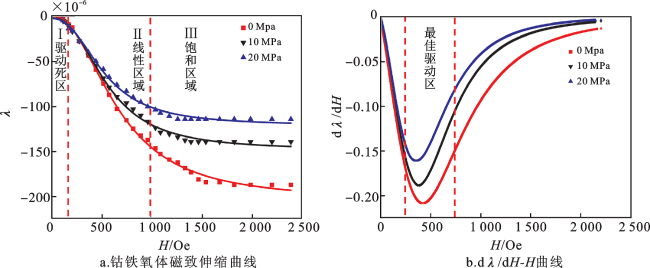
本文使用球磨法合成钴铁氧体并采用冷压烧结工艺制备块状钴铁氧体(CoFe2O4),致密度可达到88%,平均粒径为12 μm。钴铁氧体磁致伸缩曲线与压磁系数是磁致伸缩换能器设计的重要依据,通过自主搭建的磁致特性测试平台得到钴铁氧体在不同预应力下的磁致伸缩特性测试结果(见图1)。钴铁氧体在磁场驱动下产生收缩,形变量为负,图1a中,根据磁化理论磁致伸缩曲线可分为驱动死区、线性区域与饱和区域,饱和磁致伸缩系数λs随着预应力增大而减小。由0 MPa时的-186 ×10-6下降到20 MPa时的-113×10-6;图1b为压应力大小对dλ/dH-H曲线的影响,dλ/dH随磁场先增大后减小,钴铁氧体存在可取得最大dλ/dH系数的“最佳驱动区”(250~750 Oe),|dλ/dH|随着预应力增大而减小,由0 MPa时的0.23下降到20 MPa时的0.16。根据上述测试分析结果,在钴铁氧体磁致伸缩换能器设计过程中应首先保证磁场强度在“最佳驱动区”内,同时在保证结合面声耦合质量的前提下,尽量减小外加预应力。
2 磁致伸缩超声换能器结构设计
2.1 磁致伸缩超声换能器结构
图2为钴铁氧体磁致伸缩超声换能器的结构示意图。换能器主要由变幅杆、后盖板、法兰、导磁块、永磁体、磁致伸缩材料、线圈组成,其中变幅杆、磁致伸缩材料和后盖板通过预紧螺栓进行连接固定。采用大端面前接平滑圆柱体的圆锥形半波长变幅杆,法兰设置在变幅杆节面处, 偏置磁场由永磁体提供,并使用锰锌铁氧体导磁块构建磁回路减少漏磁。为防止磁路干扰,变幅杆与后盖板采用不导磁材料,驱动线圈绕制在钴铁氧体棒上,线圈将高频的电信号转换为高频的交变磁场,钴铁氧体棒在高频交变磁场驱动下产生超声振动,变幅杆通过聚能实现振幅放大输出。
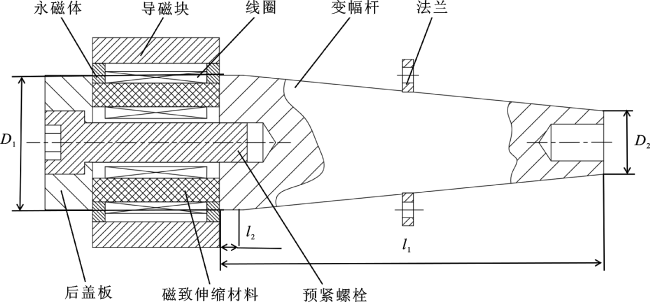
为确定磁致伸缩超声换能器各部分的尺寸,考虑为钴铁氧体块、驱动线圈、预紧螺栓的预留空间,初定大端直径D1=34 mm。换能器变幅杆小端设计有M8螺纹孔,设计小端直径D2=16 mm。
根据变截面杆一维纵振动的振速方程
+ +k2v=0。
式中:v为变幅杆质点的纵向振速;S=S(x)为变幅杆横截面的面积函数;k=2πf / c (k为圆波数,f为频率,c为纵波在变幅杆中传播速度)。
变幅杆两部分长度关系[20]为
tan kl2= 。
式中:R1为大端半径;R2为小端半径;l1为变幅杆柱面长度; l2为变幅杆锥面长度。振幅放大系数为
= · · 。
面积系数为N=R1/R2=2.125,取kl2=3。令
l1=kl2· 。
根据式(2)~(4),l1=83 mm,当kl2=3时,kl1=0.15。
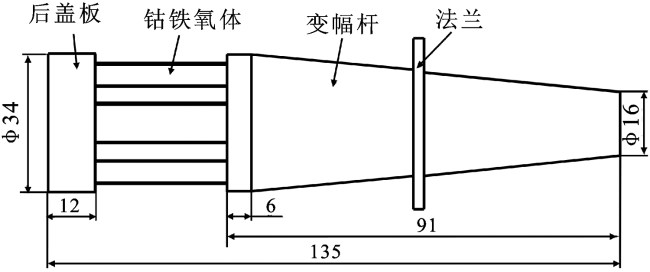
钴铁氧体与后盖板设计为1/4波长振子,使用304不锈钢为材料代入计算得到复合振子长度为43 mm,钴铁氧体棒长度为32 mm,后盖板长度为11 mm,直径与大端面直径同为34 mm,钴铁氧体块尺寸为6 mm×10 mm×32 mm,预紧螺栓型号为M10×45。使用有限元模态仿真对换能器各初步计算尺寸进行微调,最终确定尺寸如图3所示。
2.2 换能器动力学仿真
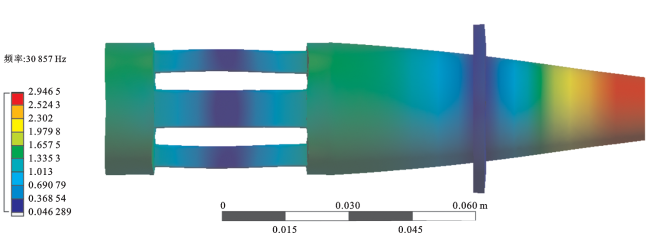
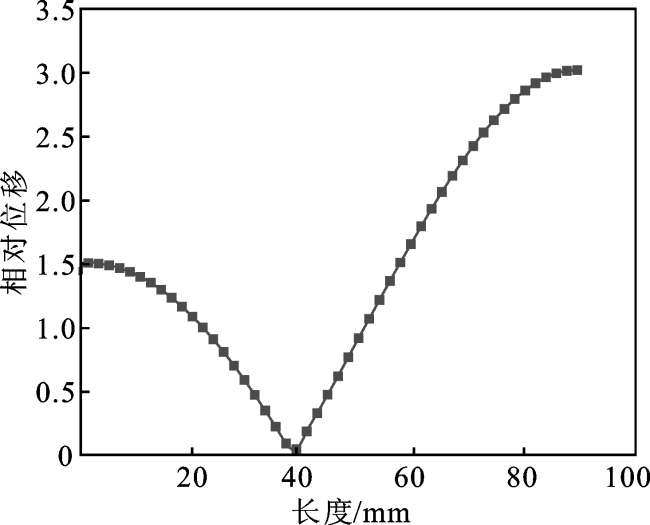
固定法兰在变幅杆节点处,最大程度地降低了固定装夹对换能器工作状态的影响。提取变幅杆大端到小端轴心线上的相对振幅比值,图5为变幅杆上各处的位移分布曲线,由曲线可知变幅杆输出端与输入端振幅放大比为2.12。
3 钴铁氧体磁致伸缩超声换能器磁场设计
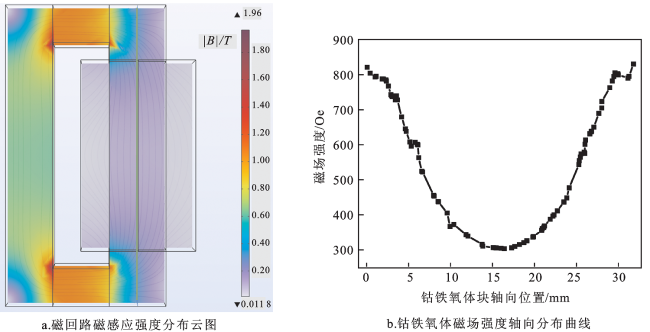
钴铁氧体材料磁导率低,为提高钴铁氧体驱动效率并消除倍频现象,需提供一定的偏置磁场,为使驱动效率最大化,应保证驱动范围在最佳驱动区(250~750 Oe)内。图6为换能器的磁路设计图,采用尺寸为4 mm×4 mm×10 mm的N35钕铁硼永磁体提供偏置磁场,为减少漏磁使用锰锌铁氧体构建磁回路,尺寸为10 mm×5 mm×32 mm。
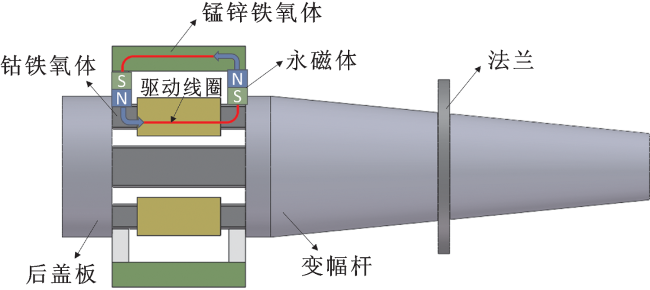
表2 部件材料与相对磁导率Tab.2 Component materials and magnetic parameters |
| 部件 | 材料 | 相对磁导率 |
|---|---|---|
| 导磁块 | 锰锌铁氧体 | 2 400 |
| 永磁体 | 钕铁硼 | 1 |
| 磁致伸缩块 | 钴铁氧体 | 4 |
4 钴铁氧体磁致伸缩超声换能器输出特性测试
为了保证带磁芯驱动线圈电磁转化效率,需要进行阻抗匹配。由于线圈是电感元件,因此必须串联适当的电容以增大有功功率提高有效电流。实验中交流驱动线圈直径为0.4 mm,每根钴铁氧体棒上绕制160匝,用LCR数字桥测量测试换能器电感,Ld = 400 μH。匹配电容根据式(5)进行计算
=2πfLd,
得到串联匹配电容Cd=70 nF。
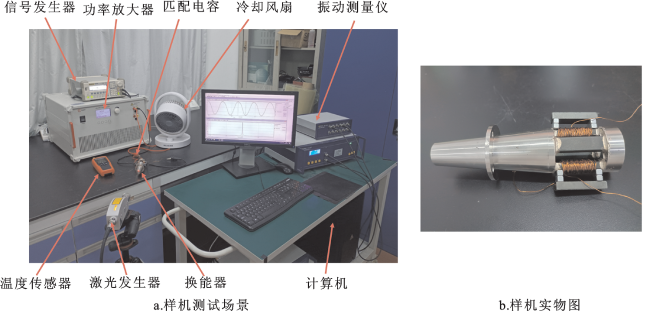
图8为钴铁氧体基磁致伸缩换能器样机和输出特性测试装置,采用RIGOL生产的DG1022V型信号发生器产生高频激励信号,之后使用Aigtek公司的ATA-3082型功率放大器放大电压信号,通过Ploytec的NLV-2500型激光发射器产生激光,由配套的数据处理盒完成信号采样处理并记录振幅数据,采样频率设为500 kHz。
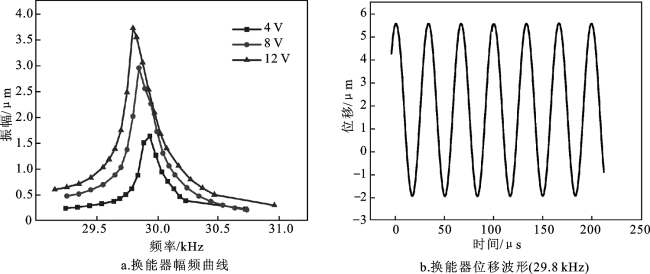
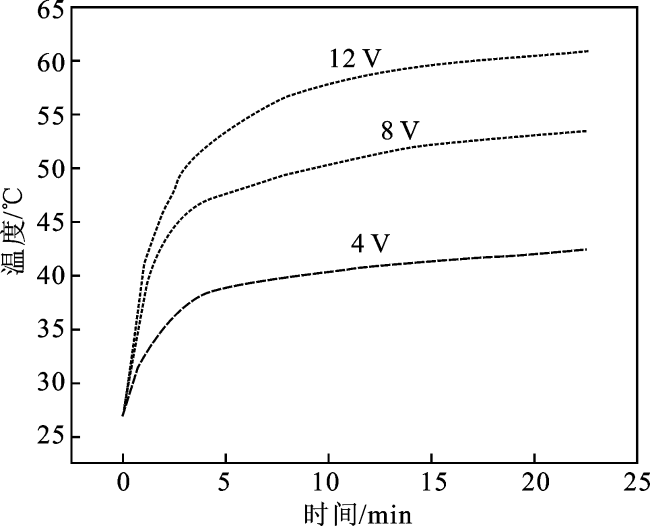
发热问题严重影响磁致伸缩换能器高频工作状态。根据磁致伸缩换能器的驱动原理,驱动核心的热量主要来自涡流损耗、磁滞损耗、线圈电阻损耗。钴铁氧体电阻率高达1×10⁻⁹Ω / m,涡流损耗小。换能器在室温风冷条件下工作,在钴铁氧体上贴有热电偶 (分辨率0.01 ℃),使用YOWEXA公司的YET-610L型高精度温度计测量钴铁氧体换能器工作时的温度变化。图10为换能器工作温升曲线,换能器温度先增大后趋于稳定,随着驱动电压增加,换能器工作温度不断升高。在4、8、12 V驱动条件下换能器稳定工作温度为42、53、60 ℃,常温风冷可以满足换能器散热需求。


5 结论
本文基于钴铁氧体作为驱动核心设计磁致伸缩超声换能器,利用有限元软件对换能器进行动力学分析,完成钴铁氧体棒上磁场感应强度分布仿真。研制钴铁氧体基磁致伸缩超声换能器样机,对样机进行阻抗匹配,测试样机输出振幅与温升曲线。得到以下结论:
1)基于一维纵向振动理论与有限元模态仿真设计钴铁氧体磁致伸缩超声换能器,共振频率与实验测试值(29.8 kHz) 的误差分别为0.6%、2.8%。换能器驱动振子为1/4波长,节面在钴铁氧体棒中间位置,变幅杆为半波结构,固定法兰在中间节面处。
2)采用钕铁硼提供偏置磁场,搭建磁回路,换能器钴铁氧体棒上偏置磁场磁感应强度为0.12~0.25 T(301~653 Oe),在“最佳驱动区”(250~750 Oe)内,满足钴铁氧体驱动要求。
3)样机谐振频率为29.8 kHz,符合频率设计要求。在串联匹配电容后,室温风冷条件下测得换能器在12 V、20 dB的驱动下振幅达到3.75 μm,稳定工作温度为60 ℃,验证了钴铁氧体在磁致伸缩超声换能器领域的巨大应用潜力。